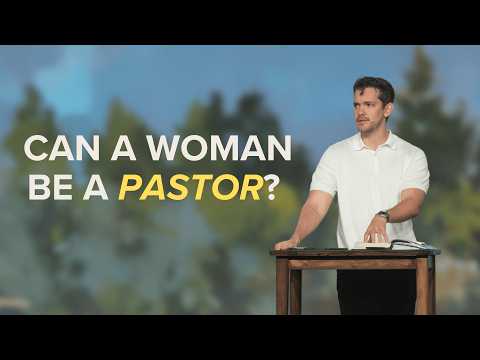
"Does the Bible Permit A Woman to Preach?" - Jonny Ardavanis
A question that is both sensitive and significant within the life of the church — examining God's design, the effects of the fall, qualifications for church leadership, and relevant passages.
Sermon Outline
-
There are a couple important topics and questions that I have not covered for two reasons over the three years that I have been the pastor here. First of all, in my normal routine of expositing through John's gospel, we do not encounter some of the questions that may need addressing. And secondly, I have hesitated to address certain things because every single week there are new people that come from an extremely diverse church and non-church backgrounds. And I'm aware of the fact that, you know, I don't, you might be visiting this morning or you may have brought a friend. And I'm always hesitant, you know, for you to bring a friend. And I brought a friend on the Sunday Johnny did this and, you know, and I um I'm sensitive to that. And as it relates to the topic that I'm going to navigate in God's word this morning, I I truly have no axe to grind. Um, but it is a question that comes up frequently in our member interviews. It's a predominant question in our culture and that is the question, does the Bible permit a woman to preach or to be a pastor? Everyone just relax. A couple statements before I dive in. I hesitate to preach on maybe the complimentarian or historic position at a time that would potentially align me with pastors online that are rude and demeaning to women in general. There are pastors online who claim women are intellectually inferior and whenever a woman rebuttals their insanity, they respond with whatever flavor of pie that that woman should be baking them or for their husband in the kitchen. That is not Christlike. it's not biblical and it gives Christianity a bad taste in the mouth of those who are both inside and outside the church. Secondly, we live in a world where we celebrate the hermeneutic of humility. And that's a a phrase that I've mentioned before, but what I mean by that is we enjoy when people say at the end of whatever they're presenting, who am I to think that I've come to the right conclusion about this passage, you know, other people disagree with me and I don't know, but this is where I stand. I would just say Paul tells Timothy in 2 Timothy 3:15 to rightly divide the word of truth, which means that there is what? A wrong way to divide the truth. A wrong way to preach the Bible. Third, and this is where I I think I'm mainly trying to be mindful of my tone and the way that I preach this morning. I understand that there is a way to preach where I simply dunk on my theological opponents and receive the amens of those who are already aligned with me. But that is not my objective. I think there are a lot of people in our world and in our church potentially that are confused, maybe on a different page, unsure of how to respond
-
respond to some of the rebuttals that they may hear. But this question this morning, does the Bible permit a woman to preach? Can a woman be a pastor? I don't think the question can be answered out of thin air. And therefore, I want to take you to the beginning of scripture so that we can understand some of the instruction that comes at the end. And after outlining some of the scriptural story and looking at some of the New Testament, what I want to do and probably spend the last 30 minutes or so doing is just responding to the nine most common rebuttals regarding the egalitarian position. Egalitarian meaning that there is really no distinction in the role between men and women. Okay? All right. You ready? I want you to take your Bibles, turn with me to Genesis 1. And I want to look first with you, if you're a notetaker, at this idea of creation. In the garden, God made two very different yet complimentary creatures. In Genesis 2:7, it says, "God made Adam from the dust of the earth and breathed into his nostrils the breath of life, and man became a living being. Adam was created before Eve." And again, this is not to say that Adam is better than Eve. First is not always best, or else beavers would be better than humans. This is to say that God had positioned Adam in the garden to be the priest and protector of Eden and gave him the responsibility of obedience to the man only. God gave the instruction in 2:15. Then the Lord God took the man and put him in the garden of Eden to cultivate it and keep it. The Lord God commanded the man, saying, "From any tree of the garden you may eat freely, but from the tree of the knowledge of good and evil you shall not eat. For in the day that you eat from it, you will surely what? >> Die. To the man was given dominion over all creation. Adam alone is responsible for naming every creature. At this point in creation, God says everything was good. And then he says something is not good. It is not good for man to be what? >> Alone. Genesis 2:20, the man gave names to all the cattle and to the birds of the sky and to every beast of the field. But for Adam there was not found a helper suitable for him. So the Lord God caused a deep sleep to fall upon the man and he slept. Then he took one of his ribs and closed up the flesh at that place. The Lord God fashioned into a woman the ri which he had taken from the man and brought her to the man. The man said, "This is now bone of my bones and flesh of my flesh. She shall be called woman because she was taken out of man." Both Adam and Eve, Genesis 1:26 says, were made in the image of God. Eve is not a lesser being. She is not an inferior creature. Both are made in the image of God and bring profound glory to God. Males do not reflect God's image more than females. But nevertheless, God made man and women different and complimentary. And this beautiful picture of men and women, a groom and a bride. The first marriage, God performed the ceremony. This is the central metaphor in all of the Bible. And in the New Testament, we read that these complimentary yet different sexes that come together in union paint a picture of Christ and his bride, which is the church. Eve was created as Adam's helper. Again, helper does not mean inferior either because multiple times in the Old Testament, God is referred to as the helper of Israel. But the isha, the woman that comes from the ish, the man was created for the man. It says, and this is why Adam is given the responsibility of naming Eve. Twice we see the emphasis that Adam is the one who names Eve, providing indication of God's design of the male operating in leadership with responsibility. Now in the garden, both the man and the woman were given responsibilities that aligned with their design. The man was responsible for tending to the ground from which he came. And the woman was responsible to tending to the man and helping the man from which she came. And at this point, God declares everything very good. Now, well, let's just turn with me to Genesis 3. The Genesis narrative functions to serve as a living warning when God's design for leadership is distorted. Satan's first attack is not only to undermine God's word, but to subvert God's design. And in 31, it says, "Now the serpent was more crafty than any beast of the field which the Lord God had made. And he said to the woman, indeed, has God said, you shall not eat from any tree of the garden. The woman said to the serpent, "From the fruit
-
fruit of the trees of the garden, we may eat, but from the fruit of the tree which is in the middle of the garden, God has said, "You shall not eat from it." And then she adds this, "Or touch it." God had never said that. Or you will die. The serpent's deception is targeted at Eve. And we will see this come into play in the New Testament. But even though it is Eve who is deceived and even though it is Eve who sins first, God holds Adam responsible. God comes to Adam in 3:9 and he calls out to the man and said to him, "Where are you?" And it is Adam who answers God. We read in Romans 5:12 that sin entered the world through one man. It doesn't say that sin enters the world through one couple or a man and a woman, but that sin entered the world through a man. This is Adam's responsibility and this is Adam's failure to lead. What happened? Eve was deceived and Adam stood passively and idly by while Eve sinned and then he followed her into sin. He was called, Adam was to be the priest and protector of the garden. He failed. And his sin was not only that he ate of the tree that God had commanded him not to, but that he passively followed his wife's leadership. Understand this. This is the first strategy of the serpent to undermine God's word and God's design. Now, secondly, look with me at the curse. The world that God had made good and glorious. Everything was to move. was very good is now broken and bent and corrupted and cursed. And that curse though manifests itself and is experienced in different ways by Adam and Eve. To Adam, God says your work is now going to be your labor is going to be by the sweat of your brow. The world Romans 8 said is going to push back. There's going to be a difficulty of working. Thorns and thistles are going to abound. because that's where Adam came from. To the woman, he says in 3:16, I will greatly multiply your pain in childbirth. And all the moms in here say, "Amen. It's going to be difficult." That's a universal principle. And then he says something else. Yet your desire will be for your husband and he will rule over you. Okay? What is that word desire? Well, let me tell you this. It's not romantic desire. That same word is used in Genesis 4:7. And it's translated another way. In Genesis 4:7, God tells Cain, "If you do well, will not your countenance be lifted up? And if you do not do well, sin is crouching at the door and its desire is for you. It's not that. It's this. But you must master it. Same idea, mastery. God tells Eve that as a derivative of the curse, you will desire to master your husband, to rule over him. I understand this is countercultural, but I'm not making anything up here. It's right here. What is the result of the fall? Women are going to fight against God's design for male leadership. What plunged the world into the fallen state in the first place is the failure of man's leadership. Now, we live in a broken world where men are often ungodly in their leadership and don't do it in a godly way. But God tells Eve here, you are going to want to overpower your husband to subvert God's design. And since page three of the Bible, this is one of the most timeless wars that has been waged in the culture, in the home, and in the church. Okay. Third, look with me at qualifications. I want to skip forward a little bit, maybe 4,000 or so years to the early church. For thousands of years in the Old Testament, there are all male kings except there's one exception which Italia, she was reigning in Israel for a time after her son was assassinated. But there are all male priests, all male ongoing
-
ongoing prophetic offices, all male authors of scripture and so forth. Now, let's talk about the office of pastor for a moment. Sometimes people say it's just semantics. I want you to know that words matter. They really matter. In the New Testament, the words for elder and pastor are used interchangeably. They refer to the same office and the same function. The first word episcopos which is often translated overseer. The second word is presbuteros which is translated as elder and the third is pomen which is often translated as pastor or shepherd. This is important that because they all refer to the same office. Now in Acts 20:1 17, Paul gathers the elders at Ephesus and he is going to leave them. He says, "You are never going to see my face again. Savage wolves are going to come in after I depart and they are going to preach to you false doctrine." And while he has gathered the presbuteros, the elders, he says this in Acts chapter 20 28, "Be on guard for yourselves and for all the flock," that's the sheep among which the Holy Spirit has made you overseers, episcopos, to shepherd, poman, the church of God. That's the word for pastor. The church of God which he has purchased with his own blood. He gathers the elders and tells them to pastor. In Titus 1, we see the same thing that an elder is a pastor and a pastor is an elder. In 1 Peter 5, Peter says this, "Therefore, I urge elders, the presbuteros among you, as your fellow elder and a witness of the sufferings of Christ and one who is also a fellow partaker of the glory that is to be revealed. Shepherd, that means pastor, the flock among of God among you, exercising oversight." Episcopas. Now, why is this worth highlighting? Well, just to affirm to you again that a pastor is an elder and an elder is a pastor. There is a reason why we do not call our children's minister a children's pastor. Why? Because our children's minister is not an elder. When he becomes an elder, Lord willing, we would call him a children's pastor. Um, today we have broadened the definition of pastor to include any and every type of oversight, but that's not necessarily biblical. And today we live in a world where people say, "This woman is a pastor, but she is not an elder." But that is biblically inongruous. Why? Because a pastor is an elder and an elder is a pastor. Now, let's look at the qualifications. If you have your Bible, turn with me to 1 Timothy 3. Qualifications for a pastor. Most noticeably, one of the requirements of being an elder or a pastor is that the elder be a man. This is the consistent pattern of male leadership established in Genesis and seen throughout the Bible. First Timothy 3, Paul tells Timothy, he's passing on the torch of the church, the church to his son in the faith. It is a trustworthy statement. If any man aspires to the office of overseer, it is a fine work. of any man. An overseer then must be above reproach the husband of one wife. That just means a onewoman man. Temperate, prudent, respectable, hospitable, and able to teach. Now, the only difference in qualifications between an elder and a deacon. Those are the two offices in the church. Again, we're not trying to write the a new book on how to do church. God establishes that in his word. And this is even addressing the subject is not because we're trying to follow some code of conduct just passed down to us from our ancestors. It's because Jesus died for our sin. He's the one that prescribes what his church should look like. And we want to live in obedience to Jesus. So he says, Paul says that the elder must be a man, a husband of one wife, able to teach. Now therefore, it would not make sense to separate the office or position of an elder from the function of an elder. What an elder does is teach and preach and train with the word of God. Now, understanding these qualifications that men are to be those who function as elders. They are to be able to teach. Let's look one chapter back and look forth with me at prohibition. the prohibition. 1 Timothy 2, it says, "A woman, verse 11, must quietly receive instruction with entire submissiveness, but I do not allow a woman to teach or exercise authority over a man, but to remain quiet." Now, pause there for a moment. It is really rather simple. The verse says nothing about women not teaching because of a lack of gifting or a lack of competency or a lack of education. It simply says that women are not to teach. This is talking to in the office of the church or exercise
-
exercise authority over men. Some female pastors and scholars have argued that that word authority exercise authority means a doineering tyrannical spirit. But there is nothing to suggest that in the text before us. 1 Corinthians 14:33 reads, "For God is not a God of confusion, but of peace." I'm thankful for that. Meaning that God does not delight in our ambiguity as as it relates to understanding his word. As in all the churches of the saints, the women are to be kept silent in the churches or to keep silent in the churches. For they are not permitted to speak, but are to subject themselves just as the law also says, "If they desire to learn anything, let them ask their own husbands at home. for it is improper for a woman to speak in church. Now, I want to pause here and just say that for 1930 years, from the writing of this epistle to about the 60s, this was case closed, no debate, not a lot of discussion. But this is I would say the most controversial, sensitive and yet I would say important issue in the western church today. Okay. You may have some rebuttals, questions, things that you've heard. I want to look at some of those, nine of them. You may be saying, "What about the context?" Some have argued that Paul is writing to the church in Ephesus that is and this prohibition that he gives is rooted in the rampant feminism that littered the Ephesian landscape. It's a feministic society and it would have looked like they were blending into the world around them if he allowed this. And so he provided this prohibition because Ephesus was very feminist. But there is nothing in the book of Acts nor the book of Ephesians that would lead us to believe that this is a feministic society. When Paul addresses the leaders of the Ephesian congregation in Acts 19 and the city leaders, they are all men. Furthermore, and most significantly, Paul does not base this prohibition in a cultural reality, but in the created order. And he takes it back to Genesis. He says in 1 Timothy 2:13, for it was Adam who was created first. Right before this, he says, I do not permit a woman to speak or exercise authority over man. Why? For it was Adam who was created first and then Eve. And it was not Adam who was deceived but the woman being deceived fell into transgression. Now that word for is a very important word in the Bible. It's the Greek word gar. Often it's called it's called the gar clause. 33 times it is used in the pastoral epistles. And every single time it expresses the cause or the reason for what Paul just said. Nine times Paul gives a a an imperative and then follows that with this word for a gar clause and it expresses the cause or the reason for what he has just said. Every single instance it is used in a causal sense. So if you were to ask the question why does God's word not permit a woman to preach? The answer would not be because Ephesus is in a feminine culture and the city and people might get the wrong idea. rather for it was Adam who was first created and then Eve and it was not Adam who was deceived but the woman being deceived fell into transgression. This is a divine order. This is a universal principle. This created order is the same reason why Jesus gives in Matthew 19 for why he values the institution of marriage. This created order is the same reason why Paul roots his argument that homosexuality is a sin and takes it back to the created order in Genesis. Those that attempt to contextualize what we read in the scripture need to be aware that Paul says 1 Corinthians 14:33 as in all the churches of the saints the women are to be kept silent. This is something we see elsewhere that phrasiology that Paul employs here as in all the churches. 1 Corinthians 4:17 for example, he says, "For this reason, I have sent to you Timothy who is my beloved and faithful child in the Lord and he will remind you of my ways which are in Christ just as I teach everywhere in every church." We need to be careful when we claim extra biblically that these things said to the early church do not apply to us because there is a context we may not know of. Why? Well, because every single book in the Bible was written to a specific people in a specific context at a specific time. Furthermore, Paul says in 1 Timothy 3:15, "I write to you so that you will know how one ought to conduct himself in the household of God, which is the church of the living God, the pillar and support of the of the truth." This is not a cultural reality. This is taking back
-
back to the created order. Second question here is what about Galatians 3:28? This is one that I read of numerous times in the last couple weeks. Galatians 3:28 reads, "There is neither Jew nor Greek. There is neither slave nor free man. There is neither male nor female. For you are all one in Christ Jesus." So people would say, "Well, the gospel obliterates gender distinction because it says that there is neither male nor female, Jew." But this is a passage talking about our standing before God. This is a a rich reality for you and I, male and female. If you're in Christ, you now stand clothed in the righteousness of Jesus Christ. and male is not superior to female. Jew not superior to Greek. Every man and woman who is a believer is a co-air with Christ and an equal heir with each other. This is a wonderful reality. But this verse is about salvation and does not abolish God's design and differentiation between man and woman. Third question, what about Deborah the judge or Miam? I I've gotten this a few times before. And in the Old Testament, there is one instance where God raised up a judge, a woman to serve as judge. And it was during a dark time in the land of Israel. And the most ubiquitous description of those living in Israel at the time is they did what was evil in the eyes of the Lord. And during this time where there was failure on Israel's part to honor the Lord, God raised up a godly and righteous woman named Deborah. But as judge, Deborah did not perform military function alongside Barack. It was to his shame that his enemy would be conquered by a woman. Furthermore, judges were national liberators. They were not officers in a formal sense. They did not wield ongoing authority. Miam and hold and even when I mention these things what about the Old Testament it's not like I feel like I need to kind of go like oh yeah absolutely no they they prophesied in the Old Testament there's an instance where it records Miam's prophecy this should be absolutely celebrated and affirmed and recognized but Miam carried no institutional authority she had no ongoing ministry and furthermore none of these women filled the office of pastor fourth question what about Priscilla. In the early church, there is a guy named Apollos. You may be familiar with him because there's a bragging situation in the early church where some people are like, "I'm team Paul. I'm team Apollos." Kind of like, "Whose side are you on? Who who are you more a fan of?" And they're they're preaching. And we're introduced to Apollos in Acts chapter 18. He's preaching. He's a believer. And a man and a woman come to him and they take him aside in private. And it says they begin to explain the word of God to him more fully. Priscilla is mentioned six times in the New Testament. Godly woman. Every single time she is mentioned, she is mentioned alongside her husband. And the example that we have of her ministry is that she took someone aside and began to explain the word of God to him more fully along with her husband. She's a godly woman. But this does not dismiss the clear teaching of the New Testament that women are not permitted to preach or fulfill the office of a pastor. Fifth question, what about the women who prophesy in 1 Corinthians 11? There are women who prophesied in the early church. Paul says in 1 Corinthians 11:5, "But every woman who prophesies," and he talks about this in the realm of head coverings, which we can talk about another time. Um, but bottom line, head coverings were a symbol of submission in the Corinthian culture. He says it's a sign of submission. That's not a sign of submission in our culture, which is why we're not telling people to wear head coverings because it'd be hard to know what that was in the first place. And that's not the way that we signal submission to our husbands in this culture. But there are women that prophesy in 1 Corinthians 11. However, we no longer believe in that type of spontaneous prophecy. That's for our day. We believe that faded out with at the conclusion of the apostolic era. But even if you are a continuationist, which just means even if you are someone that believed that the spirit of God works the same way now as he did in the apostolic age, and we have I have a number of brothers in Christ that are continuationist. I don't know any continuationists that believe that the prophecy that took place in the first century church is the same type of prophecy as when Isaiah and Jeremiah would thunder, thus says the Lord. That is a different type of prophecy. These spontaneous prophecies in the early church, they had to be weighed and they had to be judged. They were not to be immediately received. They were to be sifted. The air here would be conflating the gift of prophecy in the early church and the responsibility of teaching. Prophecy was spirit-led revelation. But teaching does not consist in bringing new revelation, but in instruction based on what God's word has already said. Prophecies were not prepared messages. Elders did not need the gift of prophecy, but they needed to be able to teach. Similarly, the first pastors were not prophets. They were teachers and preachers. Furthermore, teaching God's word carries far more weight and authority than prophecy. Because teaching the word of God has the ability to bind the conscience. And when I preach the Bible, because I'm teaching the
-
the Bible, I have the ability to say, "Thus says the word of God." No prophecies in the scripture in the early in the early first century were like that. You know why? Because they then had to be sifted. People would sit around and say, "Is this from the Lord or not?" And in this sifting, 1 Corinthians 14, women were not to sit in on the judgment of prophecies. That's the context in which Paul says, "I want a woman to remain silent during the weighing in of prophecies." Why? Why were they to be silent? Well, D. Young says, "How can a woman be submissive to her husband while at the same time telling him to submit to her judgment about his prophecy?" Paul is not commanding absolute silence in the church or else we would not have women be singing on stage. He's talking about weighing in of prophecy. And teaching, I want you to understand this is always done in the imperative mood. It is always authoritative. Those are two different things to teach or exercise authority, but they are linked. Teaching is not just explanation. It is persuasive and it is shephering. Paul tells Timothy in 1 Timothy 4:11, "Command and teach these things with some gumption." 2 Timothy 4:2, Paul tells Timothy, "Preach the word. Be ready in season and out of season. Reprove, rebuke, and exhort with complete patience and teaching." This is authoritative. When a preacher stands behind a pulpit and says, "Thus says the Lord," it is commanding. It is loving. It is shephering. And sometimes we've switched the word semantically to say, "Hey, we're gonna invite this person up to share." But when you teach the Bible, to teach the Bible biblically, Paul says, "Preach it. Reprove, rebuke, exhort." Sixth question, what about Phoebe and Junia? uh the renowned New Testament scholar NT Wright says that it is the inclusion one of the two things that really has convinced him of the egalitarian position of the is the inclusion of Phoebe in Romans 16. I'll read it for you. Paul says, "I commend you our sister Phoebe who is a servant of the church which is at Centria that you receive her in the Lord in a manner worthy of the saints and that you help her in whatever manner she may need of you. for she herself has also been a helper of many and of myself as well. That word for servant there is the same word we get for deacon. So we understand that de phoebe may have been a deaconess in this early church and Paul is sending his letter to the Romans uh by way of Phoebe. She's the one carrying his letter. Now I don't want to swing from one spectrum to the other and I would say that Phoebe is a remarkable and godly servant. She had a huge impact on the early church. God uses women. Uh but there is nothing here about her being a pastor or a preacher. A second big one, and this is kind of all the rage currently, Romans 16:7, Paul says, "Greet Andronicus and Junius, my kinsmen and my fellow prisoners who are outstanding among the apostles who are also in Christ before me." That word, that name Junius is sometimes translated Junia. And depending on different people have debated this for hundreds of years but church fathers thought that this was a man and now there's some discussion from both sides and she may it may be junia which would be a woman and secondly and it says who are outstanding among the apostles. This can be translated a couple ways. One would be hey we think they're awesome in the view of the apostles or outstanding among the apostles which means they would be amongst us. Uh so that'd be a point of debate. And then it says the uh you know but the apostles here there's different ways of translating apostles. Apostle is not always used in the technical sense meaning like one of the 12. Apostles can also just mean missionary someone that sent aposto. So regardless here Paul's saying greet this person. We think they're awesome. Maybe a missionary. We're not even sure if it's a woman. But I see nothing here that this is a female pastor or a female preacher. You'd be reading into the text and you would be providing context that doesn't exist. Okay. Now, the last three questions I have for you I think are actually the most maybe sensitive. Seventh question would be what about the way Jesus partnered with women? And I would want to say this, Jesus, it is wonderfully true, broke down barriers, befriended women, and partnered with women in ministry. Why? Because they have a huge role to play in the kingdom of God. He loved Mary and Martha. He healed the woman that was bleeding. He cared for the woman at the well. Why? Because women are made in the image of God. But Enti Wright says that the shest proof in his mind that women can be included in the pastor is that after the resurrection, Jesus tells Mary Magdalene, "Go and tell my brothers, I am risen." Of course, being able to testify to the resurrected Jesus Christ is a mutual privilege amongst both men and women alike. But if Jesus were so intent on breaking these barriers, why was another male elected as the 12th apostle after the death of Judas? Why is there no female pastor in the New Testament? Why is there no female author of scripture? Why is there no recorded sermon from a female in the New Testament? And again, I'm bouncing back and forth trying to be careful here because this is not to say that women have a lesser place in the kingdom of God at all. They've been mightily used by God. Lydia
-
Lydia and Lydia and Phoebe and Khloe and Priscilla. But I see nothing here that would denote that God's value on women means that we can circumvent the plain reading of the Bible. Number eight, what if I feel called and what if I am gifted? What if a woman feels called to pastoral ministry? One pastor said, "Feelings do not override biblical qualifications." Furthermore, this prohibition has nothing to do with giftedness or competency. You might be saying, "But there is fruit to their ministry." Well, that logic falls through because there is often fruit that comes from the ministry of pastors that are currently and presently living in sin. Fruitfulness does not equate to qualification. Furthermore, Paul says in Philippians that some preach Christ out of selfish ambition. They're preaching Christ because they want to be famous. And Paul says, "As long as Christ is preached." Meaning what? God uses people that are wrong. But that does not mean they are qualified. The last question is probably I think where I think there's s a lot of significance. What if a woman teaches under the authority of her elders on a Sunday morning? So they would say she's not an elder but she teaches under our authority. Well, listen, the Bible either says women can preach or they cannot. But this position I I would refer to as, you know, she teaches under our authority is referred to as soft complimentarianism. But I would just encourage people, you and I are not allowed to make arbitrary decisions and say,"You know what? We think she can teach under our authority once a month." A woman may be preaching under the authority of her elders, but she is most definitely not preaching under the authority of the New Testament, nor the Holy Spirit who wrote it. Sometimes churches are let off the hook because they say, "This woman teaches and preaches, but she is not an elder." But the problem is teaching and preaching are the two chief functions of an elder. That's what an elder does. And if Paul wanted to say, "I do not permit a woman to be an elder," he would have said exactly that. But he said instead, "I do not permit a woman to teach or exercise authority over man." Furthermore, this arbitrary decision of this woman can teach and this is a big thing once a month or once every other month under the authority of our elders is actually I believe more of an insult to women than just the complimentarian position because it's chosen arbitrarily and if she can teach under the authority of the elders once a month then why not under the authority of the elders every week? Who's making that decision? You may be asking, would I leave a church that has a woman preaching even if under the authority of her elders? Yes, I would. Yes, I would. I would ask the elders to reconsider their position. I would present to them scripture. And you may be asking why. What's the consequence of this? Well, the consequence of this is just it's disobedience. It's in the Bible. What's the consequence? Weak churches. And when men don't lead, churches die. And when churches break down, the culture breaks down. And you're watching this in our world today. Like in the garden, when you overthrow God's design for the family and for the church, there are disastrous consequences. You might be saying, "I'm still unconvinced." And Paul says this right after he says, "I I want a woman to remain silent." He says in 1 Corinthians 14:36, "Or was it from you that the word of God first went out? Or has it come to you only?" It's a little bit of sarcasm in the scripture. He's just saying, "Did you write the Bible?" I'm trying to be mindful, you know, just candidly because this is so against the grain of the world in which you live. If anyone thinks that he is a prophet or spiritual, let him recognize the things which are right to you are the Lord's commandment. Well, Paul this, you know, one of the most prominent female pastors today said, I did not obey the voice of a man when I surrendered my call to ministry. I surrendered to Jesus. Meaning, I don't need, you know, Paul said this, but Jesus told me to preach. No, Paul says, this is the Lord's commandment. This is from the Holy Spirit. If anyone does not recognize this, he is not recognized. In summary, and when I say in summary, I still got like seven minutes, so just hold with me. Why have a fresh view on something that the church has agreed on for about 1900 years? You know, you might be saying, well, we we we find out things all the time that are different than what people did back then. We used to think the Earth was the center of the solar system, but our opinion changed on that because we had new information that told us we were wrong. We have no new information on this because God's word is a closed book. We have been given no new revelation. All of this is old. That's why Peter says, "I want to stir you up by way of reminder. I'm not trying to conjure up something when I preach the Bible. I'm trying to take what is old as and impress it freshly upon our hearts. And when there's a new interpretation, if you're a law and order gal, you would understand the phrase the burden of proof or the term burden of proof. And the burden of proof is overwhelmingly on those who would report a new interpretation. And the proof is altogether underwhelming. I would like to affirm and this is why I wanted to spend some time at the
-
the end God's high calling for women. And this is not a PR move on my behalf. It's because I want to present a balance. And sometimes balance is kind of a euphemism for compromise. Kind of just like trying to take no side. Um I would like to affirm God's high calling for women. My life has been shaped by godly women both in my own home, my own family, but some of my heroes. Corey Timboom, Mary Sleser, Amy Carmichael. Corey Timboom will soon be her portrait will be on the wall in my office. I I love that woman. I'm excited to meet her in glory. Uh she wrote a book, Don't Wrestle, Just Nestle. That really was the impetus for me wanting to write on the subject of anxiety. Some of the brightest minds in evangelicalism are women. They are, as Paul says, co-laborers with me in the gospel. Different role. different roles in the home or the church is never an indication of different significance or worth in the eyes of God. And then we are called to mutually encourage one another in the body of Christ. Colossians 3:16 meaning that we should all be encouraging one another in the body. However, to affirm female pastors and preachers is to deny the plain reading of the Bible, to dismiss church tradition, to conduct hermeneutical gymnastics, and ignore the reality that there are no women priests, pastors, disciples, authors of scripture, and then would have to assert that the plain reading of the Bible is not plain, and that the examples of God's high value of women invalid validates the obvious reading of the Bible. The idea of a female pastor or preacher is a total violation of the word of God and brings profound injury to the church. And yet you can have the right theology and express it in the wrong ways. Churches need to be just as active in promoting what women can and should do as they are telling women what they cannot do. This is not an anti-woman church. Women have enormous value. Our church, if you know anything about our church, it's dependent upon the women that serve in so many capacities. Women are to teach and train other women. It says in Titus 2, they can train children. Timothy was taught by his own mother and grandmother. Paul tells Timothy, the future of the church, the future leader, remember what your mom taught you. Remember what your grandma taught you. I mean, this is some of the most significant influence you can have. You want to be influential says, "Hey, you can teach the next generation." That's profound. That's not, "Oh, yeah, we get the kids." No, that's significant. Very significant. You may not have your own kids. My life was changed by my fifth grade Sunday school teacher, a woman. Women can podcast. They can write books. My life has been shaped by the writing of many women. Nancy Piery, one of my favorite authors, Rosaria Butterfield. You can lead in various capacities. They can administrate. They can counsel. They can share Christ. They can love people, meet needs. Many of the people that I meet in our church that were invited by someone were invited by a woman. But to love and support these women, we must stand for God's design in the local church. And lastly, and I would say this is very important, this is as much as anything not about women sitting down as it is about men standing up, being leaders. The first great sin in the garden by Adam was pacivity, sitting idly by while the woman engaged the serpent. Al Müller said something that I think I think is really interesting. He said, "This command is so clear in the Bible because if there was any allowance, men would just watch the women do everything." Who Who's the most eager to serve in a church? Ask any pastor and they'll say the women. It's a good thing. It's a commendable thing. But this is about men as well. Not falling prey to the first temptation in human history and one that persists to this day of passivity and idleness. We need to lead. And this leadership, sometimes when we think of male leadership, maybe you've been in an environment where that call on a man to lead has been abused and men end up in turn being doineering or rude, belittling, patronizing. The leadership with which men lead is to be representative of Jesus Christ, which is sacrificial, humble, servant-hearted leadership. This is not ruthless authority. This is humble service and love. I want to affirm God's high value for women. What he's called you to do is to bless and serve in our church. And I want to challenge the men. This is very important in the scripture. And as we live in obedience to God's word, you know what God's going to do in our homes and in our church? He's going to bless it. He's going to bless our church. If you believe that, would you say amen? Let me pray. Lord Jesus, we do thank you for your word. Thank you for your truth. Lord, I pray that you would through the power of your spirit preach a stronger and clearer sermon than I could. Lord, we take this back to your design. This isn't something that we're trying to hold to arbitrarily, but rather something we're trying to obey that is objectively revealed. We pray, Lord, that you would help both the men and and the women in our church to serve and use their giftings. Um pray that men would lead in a humble Christlike way and that the women would um serve lead in various capacities um train share Christ in numerous ways. Lord I am so thankful Lord for the women in our church. Thank you for um what it is. It wouldn't be the church it is obviously without the women that serve so faithfully every single week. Lord, thank you for those who are influencing the next generation. Thank you for um the mothers in our church that are training their children. Thank you for the fathers in our church. Thank you for the single people, Lord. Thank you for the ministry that they get to wield as they use their gifts and honor you and meet needs. We love you, Lord Jesus. All of this is rooted in a desire, not because we want to adhere to some arbitrary code of conduct handed down to us by ancestors that we've never met, but because Jesus Christ is the Lord of the church and his word is the prescription for how we are to operate. And so, Lord, I pray that we would all mutually submit to the authority of the groom as your bride, the church. We pray this in your name. And all God's people said, "Amen.
Key Themes
Related Research
Ardavanis says:
"First is not always best, or else beavers would be better than humans." Then immediately: "God had positioned Adam in the garden to be the priest and protector of Eden."
He undercuts his own argument. If first doesn't mean best, why does first mean authority? The acknowledgment that creation order doesn't establish superiority should logically extend to authority as well. He cannot have it both ways — either firstness establishes precedence or it doesn't.
Ardavanis says:
"This beautiful picture of men and women, a groom and a bride... this is the central metaphor in all of the Bible... complementary yet different sexes that come together in union paint a picture of Christ and his bride, which is the church."
Yet he never quotes Ge 2:24 ("one flesh") — the text's own description of the union. One flesh cannot be a hierarchy of authority. Even though Jesus as God is clearly ruler over all His creation, the marriage metaphor is stated as a one-flesh union, not a master-slave relationship.
Key exegetical evidence from Eph 5: - Verse 22 has no verb of its own in the Greek — it borrows from v.21's "submitting to one another" (hypotassomenoi allelois). You cannot have wifely submission without mutual submission; they are the same sentence. - The husband is never told to lead, command, or exercise authority. He is told to love as Christ loved the church — which Paul defines as self-sacrifice unto death (v.25), nourishing and cherishing (v.29). This is kenosis, not command. - The "bridegroom test": How did Jesus exercise headship? He washed feet, served food, touched the untouchable, wept, asked what people wanted rather than telling them, and said "not My will but Yours." A husband who demands obedience rather than washing feet has failed the Jesus test.
Ardavanis's closing prayer is revealing: "Lord, I pray that we would all mutually submit to the authority of the groom as your bride, the church." He uses "mutual submission" language but directs it vertically (church to Christ), not horizontally (spouses to each other). The word "mutual" does the emotional work of sounding egalitarian while the structure remains one-directional.
Thank God that other scripture limits men from thinking they are god-like over others. Unfortunately, some have drawn this conclusion and acted so.
Ardavanis claims Eve "added" the phrase "or touch it" to God's command, implying she garbled what Adam relayed to her. But the Hebrew text reveals something he doesn't address.
The Singular-to-plural Shift
God's original command (Ge 2:16-17) uses exclusively second person masculine SINGULAR verb forms — addressed to Adam alone: - "you may freely eat" (achol tochel, 2ms) - "you shall not eat" (lo tochal, 2ms) - "you shall surely die" (mot tamut, 2ms)
Eve's quotation (Ge 3:2-3) uses exclusively PLURAL forms: - "we may eat" (nochel, 1st person common plural) - "you [plural] shall not eat" (lo tochlu, 2mp) - "you [plural] shall not touch" (lo tigg'u, 2mp) - "lest you [plural] die" (pen temutun, 2mp)
Eve does not quote God speaking to Adam in the singular. She quotes God speaking to THEM in the plural. The serpent also addresses them in the plural (3:1).
Three Possibilities for "or Touch It"
-
Eve added it
-
Adam added it when relaying to Eve
-
God spoke the full command to both of them after Eve's creation
Option 3 is the strongest reading because: - The "touch" clause is in the PLURAL, consistent with the rest of Eve's quotation. If Adam had added "don't touch" as his own instruction to Eve, it would logically be singular, not plural. The consistent plural argues the entire statement came from one source: God speaking to both. - If Eve added to God's words in God's presence, why didn't He correct her? Pr 30:6 says God reproves those who add to His words — but no reproof comes. - No witness in the text — not the serpent, not Adam, not God — ever charges Eve with misquoting. - Ge 1:28-29 already shows God speaking directly to both man and woman about what they may eat. Why would He withhold the prohibition from Eve? - Was adding to God's words a sin before the fall? If so, why is it never mentioned? If not, why use it to impugn Eve?
The only reading that doesn't create problems is that God spoke the full command to both of them after Eve was created, and the plural forms in Eve's quotation accurately reflect this.
From the Transcript
"Adam was created before Eve." And again, this is not to say that Adam is better than Eve. First is not always best, or else beavers would be better than humans."
Related Research
Ardavanis claims the "first strategy of the serpent" was to undermine God's word and God's design — implying the serpent's goal was to subvert a gender hierarchy by getting Eve to lead. This misreads the narrative.
Undermining God's word is the serpent's nature — "Did God really say...?" (Ge 3:1). That is what he does. But his STRATEGY was not to make Eve into a leader. His strategy was to target the one who could be deceived.
The serpent did not approach Adam because Adam could not be deceived. Paul confirms this explicitly: "Adam was not deceived, but the woman being deceived, fell into transgression" (1 Tim 2:14). Adam had direct, firsthand knowledge from God (Ge 2:16-17). He had been prepared through the naming process, through observing God's creative work, through receiving the command directly. The serpent could not trick him.
So the serpent went after Eve — not because she was "out of her lane" or "acting as leader," but because she was the vulnerable target. This is basic predatory strategy: attack where the defense is weakest.
The complementarian reading invents a motive for the serpent that the text never states. Nowhere does Genesis say the serpent wanted to reverse a leadership structure. The serpent wanted humans to disobey God, and he targeted the one he could actually mislead. That is the whole strategy.
This further reinforces that the distinction between Adam and Eve in the Fall is epistemological (knowledge vs. ignorance), not hierarchical (leader vs. follower).
Ardavanis says:
"First is not always best, or else beavers would be better than humans." Then immediately: "God had positioned Adam in the garden to be the priest and protector of Eden."
He undercuts his own argument. If first doesn't mean best, why does first mean authority? The acknowledgment that creation order doesn't establish superiority should logically extend to authority as well. He cannot have it both ways — either firstness establishes precedence or it doesn't.
Ardavanis says:
"Adam is given the responsibility of naming Eve, providing indication of God's design of the male operating in leadership with responsibility."
The text gives its own stated purpose for the naming process: "But for Adam there was not found a helper suitable for him" (Ge 2:20). God's purpose was not to establish dominion — it was to develop in Adam an awareness of relational categories through observation.
Adam was watching God create and reflecting back what he observed about the creatures — their nature, function, and connections. When Adam says "she shall be called isha because she was taken from ish," he is reflecting the source relationship God showed him, exactly as he did with the animals. This is epistemological reflection, not authority exercise.
The naming-as-authority framework collapses under its own logic: if naming = authority, then Hagar naming God ("El Roi," Ge 16:13) means Hagar exercises authority over God.
Additionally, Ardavanis wants it both ways on the command (Ge 2:15-17): the command was given to Adam alone (establishing his authority) but also applied to Eve (making her culpable). If only the direct recipient bears responsibility, Eve couldn't violate a command never given to her.
From the Transcript
"And we will see this come into play in the New Testament. But even though it is Eve who is deceived and even though it is Eve who sins first, God holds Adam resp"
Related Research
Ardavanis claims the "first strategy of the serpent" was to undermine God's word and God's design — implying the serpent's goal was to subvert a gender hierarchy by getting Eve to lead. This misreads the narrative.
Undermining God's word is the serpent's nature — "Did God really say...?" (Ge 3:1). That is what he does. But his STRATEGY was not to make Eve into a leader. His strategy was to target the one who could be deceived.
The serpent did not approach Adam because Adam could not be deceived. Paul confirms this explicitly: "Adam was not deceived, but the woman being deceived, fell into transgression" (1 Tim 2:14). Adam had direct, firsthand knowledge from God (Ge 2:16-17). He had been prepared through the naming process, through observing God's creative work, through receiving the command directly. The serpent could not trick him.
So the serpent went after Eve — not because she was "out of her lane" or "acting as leader," but because she was the vulnerable target. This is basic predatory strategy: attack where the defense is weakest.
The complementarian reading invents a motive for the serpent that the text never states. Nowhere does Genesis say the serpent wanted to reverse a leadership structure. The serpent wanted humans to disobey God, and he targeted the one he could actually mislead. That is the whole strategy.
This further reinforces that the distinction between Adam and Eve in the Fall is epistemological (knowledge vs. ignorance), not hierarchical (leader vs. follower).
Ardavanis says:
"First is not always best, or else beavers would be better than humans." Then immediately: "God had positioned Adam in the garden to be the priest and protector of Eden."
He undercuts his own argument. If first doesn't mean best, why does first mean authority? The acknowledgment that creation order doesn't establish superiority should logically extend to authority as well. He cannot have it both ways — either firstness establishes precedence or it doesn't.
Ardavanis claims the Genesis narrative is "a warning for when God's design for leadership is distorted." But this presumes hierarchy onto the text.
If God was preparing Adam through the naming/identifying process to (1) observe God's creative acts firsthand so he would have the experiential knowledge to not be deceived, and (2) develop a strong attachment to the woman as his one-flesh counterpart, then Adam's obligation to act comes from his preparation and his lack of deception — not from rank or authority.
The shock of Ge 3 is not that a hierarchy was violated. The shock is that Adam didn't help Eve despite God preparing him to be bonded to her as one flesh and giving him the knowledge to see through the serpent's lie. His failure is a failure of love and knowledge, not a failure of "leadership."
This reading is consistent with Paul's point in 1Ti 2:14: "Adam was not deceived." Paul's emphasis is on the epistemological difference — Adam knew better — not on a violated chain of command.
From the Transcript
"And we will see this come into play in the New Testament. But even though it is Eve who is deceived and even though it is Eve who sins first, God holds Adam resp"
Related Research
At 14:32, he claims that one of the qualifications for a pastor is "most noticeably" that the elder be a man, which he states is THE consistent pattern of male leadership established in Ge and seen throughout the Bible. He then emphasizes "if any man" from 1Ti 3:1.
Sigh.
The Greek τις (tis) means "anyone"
The word τις is an indefinite pronoun meaning "anyone, someone, a certain one." It is not gender-specific. There is not a single male pronoun in the entire list of requirements in 1Ti 3:1-7. He forgets the Bible was not written in English. The KJV/NASB rendering "if any man" reflects English translation convention, not the Greek text. The ESV renders it "if anyone" (εἴ τις) — because that is what it says.
Gendered language and generic usage
In gendered languages like Greek, when either male or female is possible or intended, the masculine form is used generically. This is basic Greek grammar, not a theological argument. The phrase μιᾶς γυναικὸς ἄνδρα ("one-woman man" / "husband of one wife") follows this same pattern. Paul does not need to say both — i.e., "must be either a one-wife husband or a one-husband wife" — because the masculine form of an idiom is used generically to describe faithfulness in marriage.
Paul does NOT say "must not be a woman"
If excluding women from this role were as foundational as Ardavanis claims — THE consistent pattern from Ge onward — would Paul not state it explicitly? He gives extensive qualification lists but never once says "must be male." The absence is deafening given the weight complementarians place on it.
1Ti 3:11 — "Likewise, women..."
Paul says γυναῖκας ὡσαύτως ("women likewise"). The word ὡσαύτως ("likewise, in the same way") is the same word Paul uses in 1Ti 2:9 to connect women's conduct to what came before. Here it connects women to the same office requirements just listed. "Likewise" means "in the same manner" — the same qualifications apply to women as well, with some specific additions.
Some try to read γυναῖκας as "wives [of deacons/overseers]" rather than "women [in the same role]." But this reading has serious problems:
- No possessive pronoun — it does not say "their wives" (τὰς γυναῖκας αὐτῶν). It just says "women, likewise..."
- Not all elders have wives — Paul himself was unmarried (1Co 7:7-8). Timothy likely was too. If "husband of one wife" is literal rather than idiomatic, it would disqualify Paul and Timothy from the very office Paul is instructing Timothy to fill.
- The parallel structure is role-based, not relational — 1Ti 3:1-7 covers overseers, 3:8-10 covers deacons with ὡσαύτως ("likewise"), 3:11 covers women with ὡσαύτως ("likewise"), 3:12-13 adds further deacon requirements. The repeated ὡσαύτως introduces parallel categories of servants, not subclauses about spouses.
- Phoebe is called a διάκονος (deacon) in Ro 16:1 — the same word used for male deacons in 1Ti 3:8. Paul does not use a feminized form; he uses the standard title. This confirms women held this role.
The μιᾶς γυναικὸς ἄνδρα problem
If "husband of one wife" is a literal gender requirement rather than a character requirement (faithfulness/monogamy), then: - Unmarried men are disqualified (Paul, Timothy, Jesus) - Widowers who remarry are disqualified - Men who never married are disqualified - The requirement becomes about marital status, not character — which contradicts the entire thrust of the passage, where every other item is a character trait (temperate, self-controlled, hospitable, able to teach, not a drunkard, etc.)
The phrase is an idiom for marital faithfulness — a "one-woman kind of man" — and as an idiom expressed in masculine generic form, it applies to anyone in leadership: be faithful to your spouse.
At 12:19, he says "Sometimes people say it's just semantics, but words matter, they really matter" — and then proceeds to flatten the very distinctions God's inspired words preserve.
He claims elder (πρεσβύτερος), pastor/shepherd (ποιμήν), and overseer (ἐπίσκοπος) are used interchangeably and refer to the same office and same function. If words matter, then why did Scripture use different words? The Holy Spirit inspired three distinct terms because they highlight different aspects of the same leaders' work:
- πρεσβύτερος (presbuteros) — elder: emphasizes maturity, experience, and standing in the community. Rooted in Jewish synagogue governance (cf. Ac 14:23, Tit 1:5).
- ἐπίσκοπος (episkopos) — overseer: emphasizes the function of oversight, administration, and guardianship (cf. 1Ti 3:1-2, Php 1:1).
- ποιμήν (poimēn) — shepherd/pastor: emphasizes nurture, feeding, protection — the relational and teaching dimension (Eph 4:11, 1Pe 5:2).
He rightly quotes Ac 20:28 where Paul addresses the Ephesian elders (v. 17) and tells them the Holy Spirit made them overseers to shepherd the church — all three terms applied to the same people. But this proves the words carry different emphases, not that they are synonymous. God inspired different words because there are different aspects to what these leaders do.
Further problems with his argument:
-
There is no "office of pastor." ποιμήν appears once in a leadership context (Eph 4:11) and is grammatically linked with "teacher" (τοὺς δὲ ποιμένας καὶ διδασκάλους — one article governing both nouns, Granville Sharp's rule), suggesting pastor-teacher is a function not a titled office. No individual in the NT is ever called "the pastor" of a church.
-
No man is specifically titled "pastor." Zero. How many men are specifically identified as an elder? Perhaps Peter (1Pe 5:1) and John (2Jn 1, 3Jn 1) — are there any more? With such a thin list of specifically identified elders and pastors, the confidence with which he builds restrictive rules is remarkable.
-
The NT pattern is always plural elders (Ac 14:23, Tit 1:5, Jas 5:14, 1Pe 5:1), never a single pastor leading a congregation — which is ironic given that complementarian churches typically have a single "senior pastor" exercising authority in a structure the NT never describes.
-
What IS consistent across all three terms is the character and competency requirements for anyone in leadership who is responsible for teaching and correcting (1Ti 3:1-7, Tit 1:5-9). The overlap is in qualifications, not in collapsing the terms into a single rigid "office."
If words really matter — and they do — then flattening three Spirit-inspired terms into one monolithic "office" to build a gender-exclusion argument is doing the very thing he warned against.
At 13:52, he claims that a pastor is an elder and an elder is a pastor, and says this is why they do not call a children's minister a "children's pastor" — because a pastor is an elder.
Words really matter, do they?
What is their children's minister doing? Teaching. Correcting. Feeding. Guiding. Nurturing. Protecting. Every single function that ποιμήν (shepherd/pastor) describes. The children's minister is shepherding children — that is literally the job. What does refusing to call them "pastor" achieve except denying recognition of God's calling on their life? That is not a theological distinction; it is a political one. And if the person serving as children's minister happens to be a woman — which it often is in complementarian churches — then the refusal to use "pastor" becomes transparently about gatekeeping a title, not describing a function.
The glaring self-contradiction:
- At 12:19, he insists elder, pastor, and overseer are interchangeable — same office, same function, words don't carry distinct meaning. He flattens the terms.
- At 13:52, he insists minister and pastor are not interchangeable — a minister is not a pastor because a pastor must be an elder. He now distinguishes terms that he just said were synonymous.
So which is it? When it suits his argument, three distinct Greek words collapse into one office. When it suits his argument again, two English words for the same shepherding work must be rigidly separated. He is manufacturing distinctions and collapsing them on demand.
"Today we have broadened the definition of pastor to include any and every type of oversight...but that's not necessarily biblical."
This is breathtaking. He has just spent two minutes arguing that the biblical terms are all synonymous — and now criticizes others for treating them broadly? The "broadening" he objects to is people doing exactly what he just did: treating the shepherding function as equivalent to the elder office. He flattened them when building his gender argument; now he un-flattens them to police who gets the title.
The NT reality: There is no passage that restricts the title "pastor" to a credentialed office holder while permitting identical work under a different label. The word ποιμήν means shepherd. If you are shepherding, you are pastoring. The attempt to create a minister/pastor hierarchy is an ecclesiastical invention with zero scriptural basis — and it contradicts his own thesis from 90 seconds earlier.
This is not exegesis. This is making it up as he goes along.
The irony of authoritative delivery: The very thing these so-called pastors seem to want to corner the market on is the ability to speak confidently and authoritatively on a subject. And all that gets them is a congregation of lemmings following them because of their manner of speaking and delivery instead of judging the content against the Word. This is precisely the opposite of what the Bereans did (Ac 17:11) — they examined the Scriptures daily to see whether what Paul said was true. Paul! And yet modern churchgoers are expected to accept claims from the pulpit without question simply because the speaker sounds certain. Confident delivery is not exegesis. Authority of tone is not authority of Scripture.
From the Transcript
""This woman is a pastor, but she is not an elder." But that is biblically inongruous. Why? Because a pastor is an elder and an elder is a pastor. Now, let's look at the qualifications."
Related Research
1Co 14:30-31 says: "If a revelation is made to another who is seated, the first must be silent. For you can all prophesy one by one, so that all may learn and all may be encouraged."
Paul's model for the gathered assembly includes real-time correction. If one is speaking and another has a word, the first is to stop and be quiet. This is not disorder — it is the text's own quality control mechanism for ensuring truth prevails in the assembly.
Ardavanis preaches for 47 minutes establishing a complementarian position as the only correct reading of Scripture, in a format where no one in the congregation can stand up and say "I believe you're wrong, and here's why from the text." The very structure that prevents this kind of prophetic correction is the structure being defended as biblical.
The irony is layered:
-
He teaches that certain people must be silent in church — using a format where EVERYONE is silent except him.
-
He criticizes the "hermeneutic of humility" — people unwilling to state firm positions — while operating in an environment where no one CAN challenge his firm position.
-
He believes this format protects doctrinal certainty, but 1Co 14:29 says prophecy must be WEIGHED by the others — implying the congregation has a responsibility to evaluate what is taught, not merely receive it.
-
The passage he is teaching from (1 Tim 2) is being taught in a format that Paul's own worship instructions (1 Cor 14) would not recognize.
This is not about his authority to make doctrine certain. If his reading is correct, it should survive challenge. If it cannot survive challenge, the congregation deserves to know. The single-speaker format that prevents correction does not protect the church — it harms both the speaker (who cannot be corrected) and the congregation (who cannot weigh what is said).
The fact that this question "comes up frequently in member interviews" suggests people ARE pushing back — but only in private, controlled settings where the power dynamic favors the institution. Paul's model puts the weighing in the assembly itself, in real time, where everyone can hear and learn.
At 13:52, he claims that a pastor is an elder and an elder is a pastor, and says this is why they do not call a children's minister a "children's pastor" — because a pastor is an elder.
Words really matter, do they?
What is their children's minister doing? Teaching. Correcting. Feeding. Guiding. Nurturing. Protecting. Every single function that ποιμήν (shepherd/pastor) describes. The children's minister is shepherding children — that is literally the job. What does refusing to call them "pastor" achieve except denying recognition of God's calling on their life? That is not a theological distinction; it is a political one. And if the person serving as children's minister happens to be a woman — which it often is in complementarian churches — then the refusal to use "pastor" becomes transparently about gatekeeping a title, not describing a function.
The glaring self-contradiction:
- At 12:19, he insists elder, pastor, and overseer are interchangeable — same office, same function, words don't carry distinct meaning. He flattens the terms.
- At 13:52, he insists minister and pastor are not interchangeable — a minister is not a pastor because a pastor must be an elder. He now distinguishes terms that he just said were synonymous.
So which is it? When it suits his argument, three distinct Greek words collapse into one office. When it suits his argument again, two English words for the same shepherding work must be rigidly separated. He is manufacturing distinctions and collapsing them on demand.
"Today we have broadened the definition of pastor to include any and every type of oversight...but that's not necessarily biblical."
This is breathtaking. He has just spent two minutes arguing that the biblical terms are all synonymous — and now criticizes others for treating them broadly? The "broadening" he objects to is people doing exactly what he just did: treating the shepherding function as equivalent to the elder office. He flattened them when building his gender argument; now he un-flattens them to police who gets the title.
The NT reality: There is no passage that restricts the title "pastor" to a credentialed office holder while permitting identical work under a different label. The word ποιμήν means shepherd. If you are shepherding, you are pastoring. The attempt to create a minister/pastor hierarchy is an ecclesiastical invention with zero scriptural basis — and it contradicts his own thesis from 90 seconds earlier.
This is not exegesis. This is making it up as he goes along.
The irony of authoritative delivery: The very thing these so-called pastors seem to want to corner the market on is the ability to speak confidently and authoritatively on a subject. And all that gets them is a congregation of lemmings following them because of their manner of speaking and delivery instead of judging the content against the Word. This is precisely the opposite of what the Bereans did (Ac 17:11) — they examined the Scriptures daily to see whether what Paul said was true. Paul! And yet modern churchgoers are expected to accept claims from the pulpit without question simply because the speaker sounds certain. Confident delivery is not exegesis. Authority of tone is not authority of Scripture.
Ardavanis suggests that his complementarian view is counter-cultural, implying that its friction with modern culture validates it. But culture is not how we measure truth. A view being unpopular does not make it correct any more than a view being popular makes it correct.
More importantly, his view is ALSO cultural. Complementarianism is deeply embedded in church culture — in many denominations, leadership circles, seminaries, and conferences. It is the dominant position in most evangelical institutions. It is the default assumption in countless churches. That is itself a culture.
So if "counter-cultural" is his litmus test for truth, should he reject his own position because it is cultural to the church institutions he operates within? Or does he simply presume that church culture equals biblical?
The implicit logic is:
-
My view goes against secular culture → therefore it is biblical
-
My view aligns with church culture → this alignment is ignored
This is selective reasoning. If cultural alignment disqualifies a position, it disqualifies his own. If it does not, then it cannot be used as evidence for his position either.
Truth is measured by faithful exegesis of the text, not by whether a position makes people uncomfortable. Both egalitarian and complementarian readings must stand or fall on the text itself, not on their relationship to any culture — secular or ecclesiastical.
From the Transcript
"rinthians 14:33 reads, "For God is not a God of confusion, but of peace." I'm thankful for that. Meaning that God does not delight in our ambiguity as as it relates to understanding his word."
Related Research
Ardavanis says:
"God made man and women different and complimentary."
Agreement: Yes — and this is precisely why God didn't make another man. He made a woman to rule WITH him. Their differences complement each other in the same or similar activities and roles. Two identical people don't complement each other; two different people doing the same work from different strengths do. Complementarity is an argument FOR shared labor, not divided authority.
Ardavanis says:
"This beautiful picture of men and women, a groom and a bride... this is the central metaphor in all of the Bible... complementary yet different sexes that come together in union paint a picture of Christ and his bride, which is the church."
Yet he never quotes Ge 2:24 ("one flesh") — the text's own description of the union. One flesh cannot be a hierarchy of authority. Even though Jesus as God is clearly ruler over all His creation, the marriage metaphor is stated as a one-flesh union, not a master-slave relationship.
Key exegetical evidence from Eph 5: - Verse 22 has no verb of its own in the Greek — it borrows from v.21's "submitting to one another" (hypotassomenoi allelois). You cannot have wifely submission without mutual submission; they are the same sentence. - The husband is never told to lead, command, or exercise authority. He is told to love as Christ loved the church — which Paul defines as self-sacrifice unto death (v.25), nourishing and cherishing (v.29). This is kenosis, not command. - The "bridegroom test": How did Jesus exercise headship? He washed feet, served food, touched the untouchable, wept, asked what people wanted rather than telling them, and said "not My will but Yours." A husband who demands obedience rather than washing feet has failed the Jesus test.
Ardavanis's closing prayer is revealing: "Lord, I pray that we would all mutually submit to the authority of the groom as your bride, the church." He uses "mutual submission" language but directs it vertically (church to Christ), not horizontally (spouses to each other). The word "mutual" does the emotional work of sounding egalitarian while the structure remains one-directional.
Thank God that other scripture limits men from thinking they are god-like over others. Unfortunately, some have drawn this conclusion and acted so.
1Co 14:30-31 says: "If a revelation is made to another who is seated, the first must be silent. For you can all prophesy one by one, so that all may learn and all may be encouraged."
Paul's model for the gathered assembly includes real-time correction. If one is speaking and another has a word, the first is to stop and be quiet. This is not disorder — it is the text's own quality control mechanism for ensuring truth prevails in the assembly.
Ardavanis preaches for 47 minutes establishing a complementarian position as the only correct reading of Scripture, in a format where no one in the congregation can stand up and say "I believe you're wrong, and here's why from the text." The very structure that prevents this kind of prophetic correction is the structure being defended as biblical.
The irony is layered:
-
He teaches that certain people must be silent in church — using a format where EVERYONE is silent except him.
-
He criticizes the "hermeneutic of humility" — people unwilling to state firm positions — while operating in an environment where no one CAN challenge his firm position.
-
He believes this format protects doctrinal certainty, but 1Co 14:29 says prophecy must be WEIGHED by the others — implying the congregation has a responsibility to evaluate what is taught, not merely receive it.
-
The passage he is teaching from (1 Tim 2) is being taught in a format that Paul's own worship instructions (1 Cor 14) would not recognize.
This is not about his authority to make doctrine certain. If his reading is correct, it should survive challenge. If it cannot survive challenge, the congregation deserves to know. The single-speaker format that prevents correction does not protect the church — it harms both the speaker (who cannot be corrected) and the congregation (who cannot weigh what is said).
The fact that this question "comes up frequently in member interviews" suggests people ARE pushing back — but only in private, controlled settings where the power dynamic favors the institution. Paul's model puts the weighing in the assembly itself, in real time, where everyone can hear and learn.
From the Transcript
"So the Lord God caused a deep sleep to fall upon the man and he slept. Then he took one of his ribs and closed up the flesh at that place. The Lord God fashioned in"
Related Research
At 12:19, he says "Sometimes people say it's just semantics, but words matter, they really matter" — and then proceeds to flatten the very distinctions God's inspired words preserve.
He claims elder (πρεσβύτερος), pastor/shepherd (ποιμήν), and overseer (ἐπίσκοπος) are used interchangeably and refer to the same office and same function. If words matter, then why did Scripture use different words? The Holy Spirit inspired three distinct terms because they highlight different aspects of the same leaders' work:
- πρεσβύτερος (presbuteros) — elder: emphasizes maturity, experience, and standing in the community. Rooted in Jewish synagogue governance (cf. Ac 14:23, Tit 1:5).
- ἐπίσκοπος (episkopos) — overseer: emphasizes the function of oversight, administration, and guardianship (cf. 1Ti 3:1-2, Php 1:1).
- ποιμήν (poimēn) — shepherd/pastor: emphasizes nurture, feeding, protection — the relational and teaching dimension (Eph 4:11, 1Pe 5:2).
He rightly quotes Ac 20:28 where Paul addresses the Ephesian elders (v. 17) and tells them the Holy Spirit made them overseers to shepherd the church — all three terms applied to the same people. But this proves the words carry different emphases, not that they are synonymous. God inspired different words because there are different aspects to what these leaders do.
Further problems with his argument:
-
There is no "office of pastor." ποιμήν appears once in a leadership context (Eph 4:11) and is grammatically linked with "teacher" (τοὺς δὲ ποιμένας καὶ διδασκάλους — one article governing both nouns, Granville Sharp's rule), suggesting pastor-teacher is a function not a titled office. No individual in the NT is ever called "the pastor" of a church.
-
No man is specifically titled "pastor." Zero. How many men are specifically identified as an elder? Perhaps Peter (1Pe 5:1) and John (2Jn 1, 3Jn 1) — are there any more? With such a thin list of specifically identified elders and pastors, the confidence with which he builds restrictive rules is remarkable.
-
The NT pattern is always plural elders (Ac 14:23, Tit 1:5, Jas 5:14, 1Pe 5:1), never a single pastor leading a congregation — which is ironic given that complementarian churches typically have a single "senior pastor" exercising authority in a structure the NT never describes.
-
What IS consistent across all three terms is the character and competency requirements for anyone in leadership who is responsible for teaching and correcting (1Ti 3:1-7, Tit 1:5-9). The overlap is in qualifications, not in collapsing the terms into a single rigid "office."
If words really matter — and they do — then flattening three Spirit-inspired terms into one monolithic "office" to build a gender-exclusion argument is doing the very thing he warned against.
At 14:32, he claims that one of the qualifications for a pastor is "most noticeably" that the elder be a man, which he states is THE consistent pattern of male leadership established in Ge and seen throughout the Bible. He then emphasizes "if any man" from 1Ti 3:1.
Sigh.
The Greek τις (tis) means "anyone"
The word τις is an indefinite pronoun meaning "anyone, someone, a certain one." It is not gender-specific. There is not a single male pronoun in the entire list of requirements in 1Ti 3:1-7. He forgets the Bible was not written in English. The KJV/NASB rendering "if any man" reflects English translation convention, not the Greek text. The ESV renders it "if anyone" (εἴ τις) — because that is what it says.
Gendered language and generic usage
In gendered languages like Greek, when either male or female is possible or intended, the masculine form is used generically. This is basic Greek grammar, not a theological argument. The phrase μιᾶς γυναικὸς ἄνδρα ("one-woman man" / "husband of one wife") follows this same pattern. Paul does not need to say both — i.e., "must be either a one-wife husband or a one-husband wife" — because the masculine form of an idiom is used generically to describe faithfulness in marriage.
Paul does NOT say "must not be a woman"
If excluding women from this role were as foundational as Ardavanis claims — THE consistent pattern from Ge onward — would Paul not state it explicitly? He gives extensive qualification lists but never once says "must be male." The absence is deafening given the weight complementarians place on it.
1Ti 3:11 — "Likewise, women..."
Paul says γυναῖκας ὡσαύτως ("women likewise"). The word ὡσαύτως ("likewise, in the same way") is the same word Paul uses in 1Ti 2:9 to connect women's conduct to what came before. Here it connects women to the same office requirements just listed. "Likewise" means "in the same manner" — the same qualifications apply to women as well, with some specific additions.
Some try to read γυναῖκας as "wives [of deacons/overseers]" rather than "women [in the same role]." But this reading has serious problems:
- No possessive pronoun — it does not say "their wives" (τὰς γυναῖκας αὐτῶν). It just says "women, likewise..."
- Not all elders have wives — Paul himself was unmarried (1Co 7:7-8). Timothy likely was too. If "husband of one wife" is literal rather than idiomatic, it would disqualify Paul and Timothy from the very office Paul is instructing Timothy to fill.
- The parallel structure is role-based, not relational — 1Ti 3:1-7 covers overseers, 3:8-10 covers deacons with ὡσαύτως ("likewise"), 3:11 covers women with ὡσαύτως ("likewise"), 3:12-13 adds further deacon requirements. The repeated ὡσαύτως introduces parallel categories of servants, not subclauses about spouses.
- Phoebe is called a διάκονος (deacon) in Ro 16:1 — the same word used for male deacons in 1Ti 3:8. Paul does not use a feminized form; he uses the standard title. This confirms women held this role.
The μιᾶς γυναικὸς ἄνδρα problem
If "husband of one wife" is a literal gender requirement rather than a character requirement (faithfulness/monogamy), then: - Unmarried men are disqualified (Paul, Timothy, Jesus) - Widowers who remarry are disqualified - Men who never married are disqualified - The requirement becomes about marital status, not character — which contradicts the entire thrust of the passage, where every other item is a character trait (temperate, self-controlled, hospitable, able to teach, not a drunkard, etc.)
The phrase is an idiom for marital faithfulness — a "one-woman kind of man" — and as an idiom expressed in masculine generic form, it applies to anyone in leadership: be faithful to your spouse.
Ardavanis says:
"This beautiful picture of men and women, a groom and a bride... this is the central metaphor in all of the Bible... complementary yet different sexes that come together in union paint a picture of Christ and his bride, which is the church."
Yet he never quotes Ge 2:24 ("one flesh") — the text's own description of the union. One flesh cannot be a hierarchy of authority. Even though Jesus as God is clearly ruler over all His creation, the marriage metaphor is stated as a one-flesh union, not a master-slave relationship.
Key exegetical evidence from Eph 5: - Verse 22 has no verb of its own in the Greek — it borrows from v.21's "submitting to one another" (hypotassomenoi allelois). You cannot have wifely submission without mutual submission; they are the same sentence. - The husband is never told to lead, command, or exercise authority. He is told to love as Christ loved the church — which Paul defines as self-sacrifice unto death (v.25), nourishing and cherishing (v.29). This is kenosis, not command. - The "bridegroom test": How did Jesus exercise headship? He washed feet, served food, touched the untouchable, wept, asked what people wanted rather than telling them, and said "not My will but Yours." A husband who demands obedience rather than washing feet has failed the Jesus test.
Ardavanis's closing prayer is revealing: "Lord, I pray that we would all mutually submit to the authority of the groom as your bride, the church." He uses "mutual submission" language but directs it vertically (church to Christ), not horizontally (spouses to each other). The word "mutual" does the emotional work of sounding egalitarian while the structure remains one-directional.
Thank God that other scripture limits men from thinking they are god-like over others. Unfortunately, some have drawn this conclusion and acted so.
From the Transcript
"They really matter. In the New Testament, the words for elder and pastor are used interchangeably. They refer to the same office and the same function."
Commentary
Ardavanis says:
"It is a question that comes up frequently in our member interviews."
He doesn't explicitly state agreement is required for membership, but the framing is revealing — he preaches an entire sermon establishing this as the only correct reading, in the context of membership screening. Making a debatable interpretive conclusion a membership gate is functionally making it a creedal issue — elevating it to the level of core doctrine. Question: If a prospective member said "I believe women can preach," would they be admitted?
Ardavanis says:
"We celebrate the hermeneutic of humility... 'Who am I to think I've come to the right conclusion?' I would just say Paul tells Timothy in 2Ti 3:15 to rightly divide the word of truth, which means there is a wrong way to divide the truth."
Agreement: Wishy-washy non-committal readings are unhelpful. But Ardavanis goes further — he effectively puts his own conclusions beyond challenge. He conflates confidence with certainty and humility with weakness. The Reformation principle of semper reformanda means firm convictions held with genuine willingness to be corrected by scripture. A position should never be "off the table" for reconsideration. Someone should always be willing to reform their views if shown where they are wrong in scripture.
Note: He cites 2Ti 3:15 but the "rightly dividing" verse is 2Ti 2:15. He misspoke — 3:15 is about Timothy knowing scripture from childhood.
Ardavanis says:
"First is not always best, or else beavers would be better than humans." Then immediately: "God had positioned Adam in the garden to be the priest and protector of Eden."
He undercuts his own argument. If first doesn't mean best, why does first mean authority? The acknowledgment that creation order doesn't establish superiority should logically extend to authority as well. He cannot have it both ways — either firstness establishes precedence or it doesn't.
Ardavanis says:
"To the man was given dominion over all creation."
This is flatly contradicted by Ge 1:28: "God blessed THEM; and God said to THEM, 'Be fruitful and multiply, and fill the earth, and subdue it; and rule over the fish of the sea...'" The word "them" is critical — both man and woman received the dominion mandate together.
Ardavanis's entire case builds from Ge 2 while completely ignoring Ge 1:28. The phrases "Ge 1:28," "subdue," "fill the earth," and "be fruitful" never appear anywhere in the sermon transcript. He leaps from 1:26 (image of God) to 2:15 (command to Adam alone), skipping the foundational mandate entirely. This is the most damaging gap in his argument — you cannot claim dominion was given to the man alone when the text explicitly says otherwise.
Ardavanis says:
"Adam is given the responsibility of naming Eve, providing indication of God's design of the male operating in leadership with responsibility."
The text gives its own stated purpose for the naming process: "But for Adam there was not found a helper suitable for him" (Ge 2:20). God's purpose was not to establish dominion — it was to develop in Adam an awareness of relational categories through observation.
Adam was watching God create and reflecting back what he observed about the creatures — their nature, function, and connections. When Adam says "she shall be called isha because she was taken from ish," he is reflecting the source relationship God showed him, exactly as he did with the animals. This is epistemological reflection, not authority exercise.
The naming-as-authority framework collapses under its own logic: if naming = authority, then Hagar naming God ("El Roi," Ge 16:13) means Hagar exercises authority over God.
Additionally, Ardavanis wants it both ways on the command (Ge 2:15-17): the command was given to Adam alone (establishing his authority) but also applied to Eve (making her culpable). If only the direct recipient bears responsibility, Eve couldn't violate a command never given to her.
Ardavanis says:
"Both are made in the image of God and bring profound glory to God. Males do not reflect God's image more than females."
Yet he never addresses 1Co 11:7: "For a man ought not to have his head covered, since he is the image and glory of God; but the woman is the glory of man." The phrases "glory of man," "glory of the man," and "woman is the glory" never appear in the transcript. He mentions 1 Cor 11 only for women prophesying, then punts: "he talks about this in the realm of head coverings, which we can talk about another time."
Question to press: You said both bring profound glory to God and males don't reflect God's image more. Do you then disagree with the common complementarian reading of 1 Cor 11:7? If the woman IS the glory of God equally, what does Paul mean when he distinguishes? If she is only the glory of man, how can you say males don't reflect God's image more?
Ardavanis says:
"God made man and women different and complimentary."
Agreement: Yes — and this is precisely why God didn't make another man. He made a woman to rule WITH him. Their differences complement each other in the same or similar activities and roles. Two identical people don't complement each other; two different people doing the same work from different strengths do. Complementarity is an argument FOR shared labor, not divided authority.
Ardavanis says:
"This beautiful picture of men and women, a groom and a bride... this is the central metaphor in all of the Bible... complementary yet different sexes that come together in union paint a picture of Christ and his bride, which is the church."
Yet he never quotes Ge 2:24 ("one flesh") — the text's own description of the union. One flesh cannot be a hierarchy of authority. Even though Jesus as God is clearly ruler over all His creation, the marriage metaphor is stated as a one-flesh union, not a master-slave relationship.
Key exegetical evidence from Eph 5: - Verse 22 has no verb of its own in the Greek — it borrows from v.21's "submitting to one another" (hypotassomenoi allelois). You cannot have wifely submission without mutual submission; they are the same sentence. - The husband is never told to lead, command, or exercise authority. He is told to love as Christ loved the church — which Paul defines as self-sacrifice unto death (v.25), nourishing and cherishing (v.29). This is kenosis, not command. - The "bridegroom test": How did Jesus exercise headship? He washed feet, served food, touched the untouchable, wept, asked what people wanted rather than telling them, and said "not My will but Yours." A husband who demands obedience rather than washing feet has failed the Jesus test.
Ardavanis's closing prayer is revealing: "Lord, I pray that we would all mutually submit to the authority of the groom as your bride, the church." He uses "mutual submission" language but directs it vertically (church to Christ), not horizontally (spouses to each other). The word "mutual" does the emotional work of sounding egalitarian while the structure remains one-directional.
Thank God that other scripture limits men from thinking they are god-like over others. Unfortunately, some have drawn this conclusion and acted so.
Ardavanis says:
"God tells Eve that as a derivative of the curse, you will desire to master your husband... Women are going to fight against God's design for male leadership."
Ge 3:16 is descriptive, not prescriptive. God did not curse the woman — He described consequences of sin. God is describing what WILL happen, not what SHOULD happen. Just as we use medicine to alleviate the pain of childbirth (v.16a), we should work to alleviate the domination of husbands over wives (v.16b). Both are consequences of the fall, not God's design.
Additionally, Ardavanis says Adam "stood passively and idly by while Eve sinned." But this means the very first test of the supposed authority hierarchy resulted in total failure — Adam did not lead, protect, or intervene. Maybe the hierarchy is the wrong frame.
Ardavanis claims the Genesis narrative is "a warning for when God's design for leadership is distorted." But this presumes hierarchy onto the text.
If God was preparing Adam through the naming/identifying process to (1) observe God's creative acts firsthand so he would have the experiential knowledge to not be deceived, and (2) develop a strong attachment to the woman as his one-flesh counterpart, then Adam's obligation to act comes from his preparation and his lack of deception — not from rank or authority.
The shock of Ge 3 is not that a hierarchy was violated. The shock is that Adam didn't help Eve despite God preparing him to be bonded to her as one flesh and giving him the knowledge to see through the serpent's lie. His failure is a failure of love and knowledge, not a failure of "leadership."
This reading is consistent with Paul's point in 1Ti 2:14: "Adam was not deceived." Paul's emphasis is on the epistemological difference — Adam knew better — not on a violated chain of command.
Ardavanis claims Eve "added" the phrase "or touch it" to God's command, implying she garbled what Adam relayed to her. But the Hebrew text reveals something he doesn't address.
The Singular-to-plural Shift
God's original command (Ge 2:16-17) uses exclusively second person masculine SINGULAR verb forms — addressed to Adam alone: - "you may freely eat" (achol tochel, 2ms) - "you shall not eat" (lo tochal, 2ms) - "you shall surely die" (mot tamut, 2ms)
Eve's quotation (Ge 3:2-3) uses exclusively PLURAL forms: - "we may eat" (nochel, 1st person common plural) - "you [plural] shall not eat" (lo tochlu, 2mp) - "you [plural] shall not touch" (lo tigg'u, 2mp) - "lest you [plural] die" (pen temutun, 2mp)
Eve does not quote God speaking to Adam in the singular. She quotes God speaking to THEM in the plural. The serpent also addresses them in the plural (3:1).
Three Possibilities for "or Touch It"
-
Eve added it
-
Adam added it when relaying to Eve
-
God spoke the full command to both of them after Eve's creation
Option 3 is the strongest reading because: - The "touch" clause is in the PLURAL, consistent with the rest of Eve's quotation. If Adam had added "don't touch" as his own instruction to Eve, it would logically be singular, not plural. The consistent plural argues the entire statement came from one source: God speaking to both. - If Eve added to God's words in God's presence, why didn't He correct her? Pr 30:6 says God reproves those who add to His words — but no reproof comes. - No witness in the text — not the serpent, not Adam, not God — ever charges Eve with misquoting. - Ge 1:28-29 already shows God speaking directly to both man and woman about what they may eat. Why would He withhold the prohibition from Eve? - Was adding to God's words a sin before the fall? If so, why is it never mentioned? If not, why use it to impugn Eve?
The only reading that doesn't create problems is that God spoke the full command to both of them after Eve was created, and the plural forms in Eve's quotation accurately reflect this.
Commentary: Adam's Responsibility — Knowledge and Omission, Not Leadership Rank
1 Timothy 2:13-14 19:19Ardavanis says:
"God holds Adam responsible... this is Adam's failure to lead. His sin was that he passively followed his wife's leadership." He also says: "We read in Ro 5:12 that sin entered the world through one man. It doesn't say that sin enters the world through one couple."
He gets the facts right but draws the wrong conclusion. God holds Adam responsible not because he was "the leader" but because he had knowledge and wasn't deceived. This was a sin of omission — Adam was right there (Ge 3:6, "with her," Hebrew immah), heard the entire exchange, and said nothing.
1Ti 2:13-14 is clear: only Eve was deceived. Adam was not. His sin was deliberate, with full knowledge.
The 1Ti 1 Parallel
Paul establishes a mercy spectrum in the same letter, one chapter before:
- Paul himself (1:13-16): Blasphemer, persecutor, violent aggressor — but received mercy BECAUSE he "acted ignorantly in unbelief." He calls himself a hupotyposis (pattern/template) for others who would believe.
- Hymenaeus and Alexander (1:19-20): Had faith and good conscience, REJECTED them deliberately. Handed over to Satan — the harshest discipline. No mercy.
- The woman in 2:12-15: Deceived (like Paul's former self). Receives corrective mercy — learn quietly, promised salvation. NOT excommunicated.
- Adam (2:13-14, Rom 5:12): NOT deceived. Sinned with full knowledge. Sin entered through ONE MAN — not one woman or one couple.
Paul applies the same principle throughout: mercy for the deceived/ignorant, judgment for those who sin with knowledge. The distinction is not about rank or leadership — it is about culpability based on knowledge.
Why "one Man" and not "one Couple"
Ro 5:12 attributes sin's entry to Adam alone. The complementarian claim is that Adam was the "federal head." But the text never says this. What the text says is that Adam was not deceived (1 Tim 2:14) and sinned defiantly. Ho 6:7: "Like Adam, they have transgressed the covenant; there they have dealt treacherously against Me." The Hebrew means unfaithful, deceitful, treacherous.
Sin entered through Adam because of the NATURE of his sin (deliberate, treacherous), not his ROLE (leader, head).
The Torah Establishes This Principle
Nu 15:27-31 establishes different consequences for unintentional sin (atonement available) vs. defiant sin with a high hand ("that person shall be cut off"). This is not a Pauline innovation — it is embedded in the Law. Paul applies it consistently in 1Ti 1-2.
Ge 3:17 — The Double Charge
God says to Adam: "Because you have LISTENED to the voice of your wife AND have eaten." Two charges: (1) listening without acting — the sin of omission, the silent watchman (cf. Eze 33:6), and (2) eating — direct disobedience. The listening charge only makes sense if Adam was present during the serpent's temptation and heard the entire exchange without intervening.
The Irony in Ardavanis's Reading
He acknowledges Adam "stood passively and idly by" — then concludes men should lead more. But the text's actual point is that Adam's knowledge made his silence treasonous. His culpability comes from what he knew and failed to do, not from a title he held.
Commentary: The Format That Silences Correction — 1 Corinthians 14:30-31 and Church Authority
1 Corinthians 14:30-31 17:211Co 14:30-31 says: "If a revelation is made to another who is seated, the first must be silent. For you can all prophesy one by one, so that all may learn and all may be encouraged."
Paul's model for the gathered assembly includes real-time correction. If one is speaking and another has a word, the first is to stop and be quiet. This is not disorder — it is the text's own quality control mechanism for ensuring truth prevails in the assembly.
Ardavanis preaches for 47 minutes establishing a complementarian position as the only correct reading of Scripture, in a format where no one in the congregation can stand up and say "I believe you're wrong, and here's why from the text." The very structure that prevents this kind of prophetic correction is the structure being defended as biblical.
The irony is layered:
-
He teaches that certain people must be silent in church — using a format where EVERYONE is silent except him.
-
He criticizes the "hermeneutic of humility" — people unwilling to state firm positions — while operating in an environment where no one CAN challenge his firm position.
-
He believes this format protects doctrinal certainty, but 1Co 14:29 says prophecy must be WEIGHED by the others — implying the congregation has a responsibility to evaluate what is taught, not merely receive it.
-
The passage he is teaching from (1 Tim 2) is being taught in a format that Paul's own worship instructions (1 Cor 14) would not recognize.
This is not about his authority to make doctrine certain. If his reading is correct, it should survive challenge. If it cannot survive challenge, the congregation deserves to know. The single-speaker format that prevents correction does not protect the church — it harms both the speaker (who cannot be corrected) and the congregation (who cannot weigh what is said).
The fact that this question "comes up frequently in member interviews" suggests people ARE pushing back — but only in private, controlled settings where the power dynamic favors the institution. Paul's model puts the weighing in the assembly itself, in real time, where everyone can hear and learn.
God tells Adam: "Because you listened to the voice of your wife, and have eaten from the tree..." (Ge 3:17). But in the Ge 3 narrative, Eve never speaks to Adam. She speaks to the serpent (3:1-5), takes the fruit, and gives it to him (3:6). There is no recorded dialogue from Eve to Adam.
So what "voice" did Adam listen to? He listened to her speaking to the serpent. This is further confirmation that Adam was present the entire time ("with her," Hebrew immah, Ge 3:6). He overheard the serpent's deception of Eve, had the knowledge to counter it, and said nothing.
God's charge is not "because you obeyed your wife's command" — it is "because you listened." Adam was a passive listener when he should have been an active participant. He heard the lie, knew it was a lie, and stood silent.
Ardavanis is correct that Adam "stood passively and idly by." But the text specifies WHY that passivity was damnable: Adam listened to the whole exchange and did nothing. This is the sin of the silent watchman (cf. Eze 33:6). His guilt comes from hearing the truth being distorted and choosing silence — not from failing to exercise a leadership title.
The failure to identify the actual reason Adam is blamed for bringing sin into the human race — deliberate, knowledgeable sin vs. ignorant deception — is a critical gap in the complementarian reading. They say Adam failed to lead. The text says Adam committed high treason against God. Ho 6:7 confirms: "Like Adam, they have transgressed the covenant; there they have dealt treacherously against Me."
Commentary: Deception Is Not Gender-Specific — Paul Fears It for the Whole Church
2 Corinthians 11:3 8:31Paul writes: "But I am afraid that, as the serpent deceived Eve by his craftiness, your minds will be led astray from the simplicity and purity of devotion to Christ" (2 Cor 11:3, NASB).
Paul is writing to the entire Corinthian church — men and women — and fears that ALL of them may be deceived just as Eve was. If deception were an inherently female vulnerability (as some complementarian readings of 1Ti 2:14 imply), Paul's analogy here makes no sense. Why warn men about being deceived "like Eve" if only women are susceptible to deception?
This undermines the argument that Eve's deception in Ge 3 reveals something essential about women's nature or fitness for authority. Paul treats deception as a universal human danger, not a gendered one.
Anecdotal Observation
In many households, the mother is actually harder to mislead than the father. The notion that women are more easily deceived does not match common experience. The "deceived like Eve" framing is about a specific historical event and the knowledge gap between Adam and Eve in that moment — not about an ontological difference between men and women.
The real distinction Paul draws is not male vs. female but informed vs. uninformed sin — the same mercy framework he establishes in 1Ti 1:13-16 (Paul received mercy because he acted ignorantly) and applies consistently through the letter.
Ardavanis claims Adam was called to be the "priest and protector" of the garden. Grant that for the sake of argument. The question he never asks: protect it from WHAT?
Ge 2:15 says God placed Adam in the garden "to cultivate it and keep it" (NASB). The Hebrew shamar ("keep/guard") does imply watchfulness. But what is the threat? The garden is pristine. There are no hostile nations, no wild predators threatening Eden. So what would God have Adam guarding against?
The only threat that materializes in the entire narrative is the serpent.
If God gave Adam a protective mandate, God must have prepared him to recognize the threat. This means Adam would have known:
-
That a threat existed
-
What form it would take
-
How to identify deception when he encountered it
This further reinforces that Adam was epistemologically equipped — he had knowledge Eve did not. When the serpent arrived and began twisting God's words, Adam recognized it. He was the prepared watchman. And he did nothing.
The Irony of Ardavanis's Own Argument
By calling Adam the "priest and protector," he inadvertently strengthens the egalitarian reading. If Adam was specifically prepared to guard against exactly this kind of threat, his passive silence during the serpent's deception is not a failure of hierarchical leadership — it is a dereliction of a duty he was uniquely equipped to fulfill. His guilt comes from knowledge and preparation, not from rank.
What was he protecting against? Beetles? Mold? Hail? The text gives us exactly one threat: the serpent. And Adam watched it happen in silence.
Commentary: Following a Woman Is Not the Problem — The Bible Commends It Repeatedly
Genesis 3:6; Genesis 21:12 9:08Ardavanis says Adam "passively followed his wife's leadership," framing the act of following a woman as itself the failure. She did go first, and yes, he followed without objecting. But Ardavanis misses the simple fact that following someone is not a problem. Scripture is filled with examples where a man follows a woman and it is commended:
-
God tells Abraham to listen and obey Sarah (Ge 21:12) — God Himself commands a man to follow his wife's directive.
-
Barak goes into battle under Deborah's prophetic leadership (Judg 4:8, 14) — a military commander follows a woman into war.
-
Israel, including the men, follows Deborah as judge (Judg 4:5) — they seek and submit to her judgments.
-
A military commander heeds a woman's counsel, saving the city (2 Sam 20:16, 22).
-
David follows Abigail's intervention and changes his course (1 Sam 25:33) — and praises her for it.
-
A king and his officials seek and receive authoritative word from the female prophet Huldah (2 Kgs 22:13-14).
-
Naaman follows advice from a young servant girl (2 Kgs 5:3).
-
Boaz responds positively and follows through on Ruth's request according to righteousness (Ru 3:9).
-
Mordecai and the Jews obey Esther's instruction (Esth 4:16-17).
-
The Shunammite woman directs her husband and Gehazi (2 Kgs 4:22).
-
Though prompted by Joab, David listens and is moved by the wise woman's reasoning (2 Sam 14:19).
-
The servants follow Mary's directive at the wedding, leading to Jesus' first sign (Jn 2:5).
-
Men respond to and follow the Samaritan woman's testimony to Christ (Jn 4:39).
-
Jesus entrusts the witness of His resurrection to women (Lk 24:6, 9-12).
-
Priscilla instructs Apollos (Ac 18:26).
-
Lydia leads her household (Ac 16:15).
And finally: what woman who follows the example of Christ should not herself be followed, just as we are to follow Paul's example as he emulates Christ (1 Cor 11:1)?
The Actual Problem With Adam
Adam's sin was not that he followed a woman. His sin was that he followed into disobedience with full knowledge that it was wrong. He was not deceived (1 Tim 2:14). He knew exactly what the fruit was and what God had said. If following a woman were inherently sinful, God would not have commanded Abraham to do it, and Scripture would not repeatedly commend it.
The complementarian framing — "he passively followed his wife's leadership" — smuggles in the assumption that a man following a woman is a violation of God's design. But the biblical witness says the opposite: men following women is commended when the direction is righteous, and condemned when the direction is sinful. The variable is the content and knowledge, not the gender of who leads.
Ardavanis claims the "first strategy of the serpent" was to undermine God's word and God's design — implying the serpent's goal was to subvert a gender hierarchy by getting Eve to lead. This misreads the narrative.
Undermining God's word is the serpent's nature — "Did God really say...?" (Ge 3:1). That is what he does. But his STRATEGY was not to make Eve into a leader. His strategy was to target the one who could be deceived.
The serpent did not approach Adam because Adam could not be deceived. Paul confirms this explicitly: "Adam was not deceived, but the woman being deceived, fell into transgression" (1 Tim 2:14). Adam had direct, firsthand knowledge from God (Ge 2:16-17). He had been prepared through the naming process, through observing God's creative work, through receiving the command directly. The serpent could not trick him.
So the serpent went after Eve — not because she was "out of her lane" or "acting as leader," but because she was the vulnerable target. This is basic predatory strategy: attack where the defense is weakest.
The complementarian reading invents a motive for the serpent that the text never states. Nowhere does Genesis say the serpent wanted to reverse a leadership structure. The serpent wanted humans to disobey God, and he targeted the one he could actually mislead. That is the whole strategy.
This further reinforces that the distinction between Adam and Eve in the Fall is epistemological (knowledge vs. ignorance), not hierarchical (leader vs. follower).
Ardavanis presents Adam's and Eve's curses as distinct experiences — Adam gets "toil" working the ground, Eve gets "pain" in childbirth — as if God is using different language to describe fundamentally different things. But the Hebrew tells a different story: the same word (itstsabon / etsev) is used for both. Adam toils working the ground; Eve toils in bearing children. The parallelism is intentional.
Ardavanis's framing makes it sound like women were designed to experience pain in childbirth as a permanent feature of the curse. But this does not hold up: - Some women bypass birthing pain entirely. - Some men never work the ground a single day in their lives.
These were words spoken specifically to Adam and Eve in their immediate situation, not universal prescriptions for all men and women for all time.
The Context of Eve's Toil
Tending the garden and ruling over creation and creatures was given to BOTH Adam and Eve (Ge 1:28). Eve shares the same dominion mandate. But now, after the Fall, death has entered. Eve must bear many children because she is going to die. There is an urgency to reproduction that did not exist before — mortality demands it.
This reframes Eve's toil in childbearing not as punishment but as the consequence of mortality pressing on the mandate to fill the earth. It is not a bad thing that she toils in bearing children — it is the weight of doing necessary, life-giving work under the new reality of death. The same applies to Adam's toil: sustaining life from the ground is not punishment per se but the increased difficulty of fulfilling the same mandate in a now-hostile environment.
Both are toiling. Both are laboring under the weight of mortality. The text uses the same word because the experience is parallel, not gendered into separate categories of curse.
Ardavanis says that Eve's "desire" for her husband (Ge 3:16) is not romantic desire, and he prefers the parallel in Ge 4:7 where sin "desires" to master Cain. But there are two problems with this reading.
The Two Uses of Teshuqah
-
Ge 4:7 — Sin's desire toward Cain (desire to master/consume).
-
*So 7:10* — The bride's desire for the bridegroom (romantic, relational longing).
Ardavanis strangely prefers the Ge 4 parallel. But here is the critical point: NOWHERE does Ge 3:16 say that the woman desires to RULE her husband. That is inserted by inference. The text says only that she will desire him — teshuqah toward him. The leap from "desire" to "desire to dominate" is not in the text.
Why She Would Need to Desire Him at All
Consider what has just happened. Adam was present during the serpent's deception (Ge 3:6, "with her"). He had the knowledge to see through the lie. He said nothing. He watched Eve be deceived, watched her eat, and then ate himself with full knowledge.
When Eve realizes what happened — that Adam knew the truth about the serpent and the fruit and did not protect her — she is going to be justifiably furious. Furious enough to leave him. Imagine: this could have been the first divorce. And if it were, there would be no human race. The mandate to fill the earth (Ge 1:28) would end before it began.
God's Prophecy, Not a Prescription
God is not prescribing a desire to dominate. God is prophesying that despite Adam's treachery against her and against God, she will still desire him — she will stay. The Song of Solomon parallel (romantic/relational longing) fits far better than the Ge 4 parallel (hostile mastery). Eve will want her husband even though he failed her catastrophically.
And Adam's Response — "He Will Rule Over You"
What does Adam do with this? Rather than repenting of his passive failure, he overcompensates. As if to make sure his failure never happens again, he puts her under his thumb. He will rule over her. This is not God's design — it is the consequence of the Fall. Adam's rule over Eve is reactive, born from guilt and the determination to control what he failed to protect.
Ge 3:16 is descriptive of what WILL happen as a result of the Fall — not prescriptive of what SHOULD happen by God's design. The woman will desire her husband despite his betrayal; the man will dominate her out of his failure. Both are tragic consequences, not blueprints for marriage.
Commentary: "Counter-Cultural" Is Not a Truth Test — And His View Is Also Cultural
1 Corinthians 14:34-35 11:00Ardavanis suggests that his complementarian view is counter-cultural, implying that its friction with modern culture validates it. But culture is not how we measure truth. A view being unpopular does not make it correct any more than a view being popular makes it correct.
More importantly, his view is ALSO cultural. Complementarianism is deeply embedded in church culture — in many denominations, leadership circles, seminaries, and conferences. It is the dominant position in most evangelical institutions. It is the default assumption in countless churches. That is itself a culture.
So if "counter-cultural" is his litmus test for truth, should he reject his own position because it is cultural to the church institutions he operates within? Or does he simply presume that church culture equals biblical?
The implicit logic is:
-
My view goes against secular culture → therefore it is biblical
-
My view aligns with church culture → this alignment is ignored
This is selective reasoning. If cultural alignment disqualifies a position, it disqualifies his own. If it does not, then it cannot be used as evidence for his position either.
Truth is measured by faithful exegesis of the text, not by whether a position makes people uncomfortable. Both egalitarian and complementarian readings must stand or fall on the text itself, not on their relationship to any culture — secular or ecclesiastical.
Commentary: God Never Said She Would Want to "Overpower" Her Husband
Genesis 3:16; 1 Corinthians 7:3-5 11:31At 11:31, Ardavanis claims that God tells Eve she is going to want to "overpower her husband" and "subvert God's design," and calls this "one of the most timeless wars waged in culture."
God Says No Such Thing
The text of Ge 3:16 says her teshuqah (desire/longing) will be for her husband. Nowhere does God say she will want to overpower him. Ardavanis is adding to God's words — inserting "overpower" and "subvert" where the text says "desire." This is eisegesis, not exegesis.
The Real War
Maybe the "timeless war" is not women trying to overpower men, but men putting their wives under their thumbs — which is exactly what Ge 3:16b describes as a consequence of the Fall: "he will rule over you." If there is a war, the text locates the aggression in the man's domination, not the woman's desire.
The Irony of "Overpower"
Isn't it odd? Women are supposedly trying to overpower their husbands — but husbands are designed to overpower their wives, not only physically but now also in every other way according to this reading. The complementarian framework gives men authority over women in the home, the church, and leadership — and then frames women's resistance to that authority as rebellion against God.
Paul's Equal Treatment in 1Co 7
Paul seems to have no awareness of this supposed power struggle. In 1Co 7:3-5, every situation and obligation is stated of both the husband and the wife equally:
- The husband should fulfill his duty to his wife, and likewise the wife to her husband (v. 3)
- The wife does not have authority over her own body, but the husband does; and likewise the husband does not have authority over his own body, but the wife does (v. 4)
- Do not deprive one another (v. 5)
This is the only passage in the New Testament where authority (exousia) is explicitly addressed within marriage — and it is literally equal in every way. Each spouse has authority over the other's body. There is no hierarchy, no chain of command, no "head" exercising unilateral authority.
If God had designed marriage with a leadership hierarchy and women were waging a "timeless war" to overthrow it, Paul missed the memo entirely.
Adding to God's Words — "I'm Not Making This Up"
11:05At 11:05, he says that he understands that this is countercultural, but he is not making anything up here, it's right here. And then he literally adds to God's words. If someone has to tell you that they are not making something up, they are probably making something up!
Faulty Summary of Human History — Kings, Priests, Prophets, Authors
11:56At 11:56, he tries to summarize human history by saying that there were all male kings with one exception, all male priests, all male ongoing prophetic offices, all male authors of scripture and so forth.
Kings: A female "king" is called a queen, not a king. Surely he's jesting.
Priests: Priests have strict requirements. Only one tribe and only males without any defect and only if ceremonially clean. Is this really about males? There is a sense that the male is first just like the Jews are first. Paul says "first to the Jew and then the Gentile" (Ro 1:16) but we don't require only Jewish leaders in our churches. You could become Jewish by being circumcised and obeying the law, but a woman cannot become a man. Also, if we are a kingdom of priests (1Pe 2:9, Rev 1:6), does that only refer to males? If the temple is the body of the believer, is not a person a priest of their own body offering up spiritual sacrifices? We no longer have priests in the NT either, at least not as a distinct role required because of temple sacrifices since sacrifices are no longer performed.
Prophets: What does he mean by "all male ongoing prophetic offices"? What is meant by "ongoing"? Surely he realizes there were and are female prophets. Who was Huldah (2Ki 22:14)? Deborah (Jdg 4:4)? Even in 1Co 11 it is presumed females prophesy in the gathering and there is no M/F distinction being made in 1Co 14 when it says all should desire to prophesy.
Authors of Scripture: Who wrote Ruth? Esther? How about Hebrews which seems to have a primary author and also a "we/us" (likely Priscilla and Aquila in my opinion).
"Words Matter" — Elder, Pastor, Overseer Distinctions
12:19At 12:19, he says "Sometimes people say it's just semantics, but words matter, they really matter" — and then proceeds to flatten the very distinctions God's inspired words preserve.
He claims elder (πρεσβύτερος), pastor/shepherd (ποιμήν), and overseer (ἐπίσκοπος) are used interchangeably and refer to the same office and same function. If words matter, then why did Scripture use different words? The Holy Spirit inspired three distinct terms because they highlight different aspects of the same leaders' work:
- πρεσβύτερος (presbuteros) — elder: emphasizes maturity, experience, and standing in the community. Rooted in Jewish synagogue governance (cf. Ac 14:23, Tit 1:5).
- ἐπίσκοπος (episkopos) — overseer: emphasizes the function of oversight, administration, and guardianship (cf. 1Ti 3:1-2, Php 1:1).
- ποιμήν (poimēn) — shepherd/pastor: emphasizes nurture, feeding, protection — the relational and teaching dimension (Eph 4:11, 1Pe 5:2).
He rightly quotes Ac 20:28 where Paul addresses the Ephesian elders (v. 17) and tells them the Holy Spirit made them overseers to shepherd the church — all three terms applied to the same people. But this proves the words carry different emphases, not that they are synonymous. God inspired different words because there are different aspects to what these leaders do.
Further problems with his argument:
-
There is no "office of pastor." ποιμήν appears once in a leadership context (Eph 4:11) and is grammatically linked with "teacher" (τοὺς δὲ ποιμένας καὶ διδασκάλους — one article governing both nouns, Granville Sharp's rule), suggesting pastor-teacher is a function not a titled office. No individual in the NT is ever called "the pastor" of a church.
-
No man is specifically titled "pastor." Zero. How many men are specifically identified as an elder? Perhaps Peter (1Pe 5:1) and John (2Jn 1, 3Jn 1) — are there any more? With such a thin list of specifically identified elders and pastors, the confidence with which he builds restrictive rules is remarkable.
-
The NT pattern is always plural elders (Ac 14:23, Tit 1:5, Jas 5:14, 1Pe 5:1), never a single pastor leading a congregation — which is ironic given that complementarian churches typically have a single "senior pastor" exercising authority in a structure the NT never describes.
-
What IS consistent across all three terms is the character and competency requirements for anyone in leadership who is responsible for teaching and correcting (1Ti 3:1-7, Tit 1:5-9). The overlap is in qualifications, not in collapsing the terms into a single rigid "office."
If words really matter — and they do — then flattening three Spirit-inspired terms into one monolithic "office" to build a gender-exclusion argument is doing the very thing he warned against.
Children's Minister vs. Pastor — The Self-Contradiction
13:52At 13:52, he claims that a pastor is an elder and an elder is a pastor, and says this is why they do not call a children's minister a "children's pastor" — because a pastor is an elder.
Words really matter, do they?
What is their children's minister doing? Teaching. Correcting. Feeding. Guiding. Nurturing. Protecting. Every single function that ποιμήν (shepherd/pastor) describes. The children's minister is shepherding children — that is literally the job. What does refusing to call them "pastor" achieve except denying recognition of God's calling on their life? That is not a theological distinction; it is a political one. And if the person serving as children's minister happens to be a woman — which it often is in complementarian churches — then the refusal to use "pastor" becomes transparently about gatekeeping a title, not describing a function.
The glaring self-contradiction:
- At 12:19, he insists elder, pastor, and overseer are interchangeable — same office, same function, words don't carry distinct meaning. He flattens the terms.
- At 13:52, he insists minister and pastor are not interchangeable — a minister is not a pastor because a pastor must be an elder. He now distinguishes terms that he just said were synonymous.
So which is it? When it suits his argument, three distinct Greek words collapse into one office. When it suits his argument again, two English words for the same shepherding work must be rigidly separated. He is manufacturing distinctions and collapsing them on demand.
"Today we have broadened the definition of pastor to include any and every type of oversight...but that's not necessarily biblical."
This is breathtaking. He has just spent two minutes arguing that the biblical terms are all synonymous — and now criticizes others for treating them broadly? The "broadening" he objects to is people doing exactly what he just did: treating the shepherding function as equivalent to the elder office. He flattened them when building his gender argument; now he un-flattens them to police who gets the title.
The NT reality: There is no passage that restricts the title "pastor" to a credentialed office holder while permitting identical work under a different label. The word ποιμήν means shepherd. If you are shepherding, you are pastoring. The attempt to create a minister/pastor hierarchy is an ecclesiastical invention with zero scriptural basis — and it contradicts his own thesis from 90 seconds earlier.
This is not exegesis. This is making it up as he goes along.
The irony of authoritative delivery: The very thing these so-called pastors seem to want to corner the market on is the ability to speak confidently and authoritatively on a subject. And all that gets them is a congregation of lemmings following them because of their manner of speaking and delivery instead of judging the content against the Word. This is precisely the opposite of what the Bereans did (Ac 17:11) — they examined the Scriptures daily to see whether what Paul said was true. Paul! And yet modern churchgoers are expected to accept claims from the pulpit without question simply because the speaker sounds certain. Confident delivery is not exegesis. Authority of tone is not authority of Scripture.
"If Any Man" — τις Is Gender-Neutral, and 1Ti 3 Does Not Exclude Women
14:32At 14:32, he claims that one of the qualifications for a pastor is "most noticeably" that the elder be a man, which he states is THE consistent pattern of male leadership established in Ge and seen throughout the Bible. He then emphasizes "if any man" from 1Ti 3:1.
Sigh.
The Greek τις (tis) means "anyone"
The word τις is an indefinite pronoun meaning "anyone, someone, a certain one." It is not gender-specific. There is not a single male pronoun in the entire list of requirements in 1Ti 3:1-7. He forgets the Bible was not written in English. The KJV/NASB rendering "if any man" reflects English translation convention, not the Greek text. The ESV renders it "if anyone" (εἴ τις) — because that is what it says.
Gendered language and generic usage
In gendered languages like Greek, when either male or female is possible or intended, the masculine form is used generically. This is basic Greek grammar, not a theological argument. The phrase μιᾶς γυναικὸς ἄνδρα ("one-woman man" / "husband of one wife") follows this same pattern. Paul does not need to say both — i.e., "must be either a one-wife husband or a one-husband wife" — because the masculine form of an idiom is used generically to describe faithfulness in marriage.
Paul does NOT say "must not be a woman"
If excluding women from this role were as foundational as Ardavanis claims — THE consistent pattern from Ge onward — would Paul not state it explicitly? He gives extensive qualification lists but never once says "must be male." The absence is deafening given the weight complementarians place on it.
1Ti 3:11 — "Likewise, women..."
Paul says γυναῖκας ὡσαύτως ("women likewise"). The word ὡσαύτως ("likewise, in the same way") is the same word Paul uses in 1Ti 2:9 to connect women's conduct to what came before. Here it connects women to the same office requirements just listed. "Likewise" means "in the same manner" — the same qualifications apply to women as well, with some specific additions.
Some try to read γυναῖκας as "wives [of deacons/overseers]" rather than "women [in the same role]." But this reading has serious problems:
- No possessive pronoun — it does not say "their wives" (τὰς γυναῖκας αὐτῶν). It just says "women, likewise..."
- Not all elders have wives — Paul himself was unmarried (1Co 7:7-8). Timothy likely was too. If "husband of one wife" is literal rather than idiomatic, it would disqualify Paul and Timothy from the very office Paul is instructing Timothy to fill.
- The parallel structure is role-based, not relational — 1Ti 3:1-7 covers overseers, 3:8-10 covers deacons with ὡσαύτως ("likewise"), 3:11 covers women with ὡσαύτως ("likewise"), 3:12-13 adds further deacon requirements. The repeated ὡσαύτως introduces parallel categories of servants, not subclauses about spouses.
- Phoebe is called a διάκονος (deacon) in Ro 16:1 — the same word used for male deacons in 1Ti 3:8. Paul does not use a feminized form; he uses the standard title. This confirms women held this role.
The μιᾶς γυναικὸς ἄνδρα problem
If "husband of one wife" is a literal gender requirement rather than a character requirement (faithfulness/monogamy), then: - Unmarried men are disqualified (Paul, Timothy, Jesus) - Widowers who remarry are disqualified - Men who never married are disqualified - The requirement becomes about marital status, not character — which contradicts the entire thrust of the passage, where every other item is a character trait (temperate, self-controlled, hospitable, able to teach, not a drunkard, etc.)
The phrase is an idiom for marital faithfulness — a "one-woman kind of man" — and as an idiom expressed in masculine generic form, it applies to anyone in leadership: be faithful to your spouse.
Your Tags
Personal labels you apply to any item — separate from system topics. Tags are shared across all databases. Visit /tags to browse all your tags.
...more
Personal labels you apply to any item — separate from system topics. Tags are shared across all databases. Visit /tags to browse all your tags.
...more