Shaming The Head 3
Continuing our verse by verse through 1 Corinthians 11, we come to verse 6:
Date: 2007-07-21
URL: https://mmoutreach.org/wim/2007/07/21/shaming-the-head-3/
Continuing our verse by verse through 1 Corinthians 11, we come to verse 6:
For if a woman does not cover her head, let her also have her hair cut off; but if it is disgraceful for a woman to have her hair cut off or her head shaved, let her cover her head.
We have already discussed that the cultural view of women’s hair coverings is “covered” in verse 5. We have also seen that Paul takes a non-traditional view of women by telling the men that his wife is his glory. Paul reveals that the tradition of women being covered is not God’s way of dealing with glory. Glory is meant to be shown or revealed and not covered up. Just as a man reveals God’s glory and is not to cover his head, so a woman reveals the glory of man and she too should be uncovered.
Women whose husbands are Christians and who understand the women’s freedom in Christ to reveal the glory of the Lord just as men reveal the glory of the Lord (2 Corinthians 3:18) will have no reason to insist their wives cover themselves because of man’s tradition. So Paul says that “if a woman does not cover her head” then “let her also have her hair cut off”. Here Paul is talking about a woman’s freedom to have her hair cut. Is it wrong for a woman to get a hair cut? Is it wrong for her to have short hair? Paul says the tradition of not cutting one’s hair is in the same category as the tradition that women must wear a head covering.
The woman is her husband’s glory and as such she should be free from the tradition of having to cover her head. Covering the head symbolized both modesty and shame. See the previous post about what the culture thought was the woman’s shame. Once a woman is free from the tradition of covering her head, she is also free from the tradition that a woman must have long hair. She may cut her hair and this act is not breaking God’s law. This tradition is not God’s tradition. Why is that? We know that God does not forbid a woman to have her hair cut because God had regulations for a Nazirite vow that required men and women to grow their hair out when they took the vow and then later when the vow was finished, both men and women were required to shave their hair off. So if God required the woman who takes this vow to shave her hair off, then it could not be against God’s law for her to cut her hair.
If a Jewish woman who had become a Christian wanted to take a Nazirite vow, when the vow was finished, she would be required by God to shave off her hair. If a woman who had shaved off her hair was in the congregation without a head covering, she may experience shame because she had no hair. Paul made allowance for this last “shame” and he said that if it is disgraceful for a woman to have her hair cut or her hair shaved off, then she was allowed to cover her head if she had a bald head or her hair had not yet grown out. Paul gives her permission to cover her head by saying “let her cover her head”. Paul never demands that she cover, he just gives her a choice to cover.
The rules for the Nazirite vow are in Numbers chapter 6.
Numbers 6:2 Speak to the sons of Israel and say to them, ‘When a man or woman makes a special vow, the vow of a Nazirite, to dedicate himself to the LORD,
Numbers 6:5 All the days of his vow of separation no razor shall pass over his head. He shall be holy until the days are fulfilled for which he separated himself to the LORD; he shall let the locks of hair on his head grow long.
Numbers 6:13 Now this is the law of the Nazirite when the days of his separation are fulfilled, he shall bring the offering to the doorway of the tent of meeting.
Numbers 6:18 The Nazirite shall then shave his dedicated head of hair at the doorway of the tent of meeting, and take the dedicated hair of his head and put it on the fire which is under the sacrifice of peace offerings.
The man or woman who had taken a Nazirite vow was required to shave off their hair and put it on the fire as a sacrifice. Both men and women then who had taken this vow would be bald. Men would not experience shame from being bald, but many women would experience shame from their baldness.
Paul allows a woman who has a bald head and who would experience shame because of her bald head to cover her head with a head covering. Paul has given two reasons for shame in chapter 11 that a woman may want to continue to wear a head covering. The first reason was that she may bring her non-Christian husband shame if she is caught in public without her head covering, since he may divorce her for defying the cultural tradition of the head covering.
The second reason that a woman may be covered is because of her own shame. If she was bald or if her hair had not yet fully grown out after she had taken a Nazirite vow, Paul allows her to cover her head. Paul gives a woman permission to veil because of two possible kinds of shame, but Paul never gives the man permission to veil since the culture of the day did not bring shame to a man who had a bald head and the only cultural reason for a man’s head covering shamed Christ.
Paul’s purpose in the discussion of the head covering is to bring Christians to a biblical view of our reflected glory and to discard the faulty cultural view of shame. Paul shows us in 2 Corinthians 3:18 the importance of the unveiled face:
But we all, with unveiled face, beholding as in a mirror the glory of the Lord, are being transformed into the same image from glory to glory, just as from the Lord, the Spirit.
While some have seen 1 Corinthians 11 as a mandate for women to wear the veil, a close inspection of the passage shows that Paul is advocating the exact opposite. He is not upholding man’s tradition, but blowing that tradition out of the water. Paul shows that it is God’s will that glory is to be uncovered not hidden, and man’s tradition of forcing the woman to be covered because her uncovering shamed him, is the complete opposite of what God teaches. The woman is the man’s glory not his shame. And as the man’s glory she is to be revealed not hidden.
Since we have already covered verse 10 in a previous post, the next post will pick up at verse 11 and discuss the importance of origins and interdependence.

 Cheryl
2007-07-22
Cheryl
2007-07-22
Justa Berean,
You can hear the audio at my post below. Audio #6 is the quote where Moore says that egalitarians are shaking their fists in the face of authority and it is a spiritual warfare issue and lives are at stake (therefore we must repent) and the gospel is at stake (therefore we must believe the complementarian gospel).
http://strivetoenter.com/wim/2007/03/24/should-cbmw-fight-egalitarians/
 Cheryl
2007-07-25
★
Cheryl
2007-07-25
★
“H”,
Your point is well taken. If we continue to lift scriptures from their context, then we are left with following a new “law” to the letter – are men lifting their hands in prayer as Paul “required” (1 Timothy 2:8)? Are women to be silenced completely in church not even saying “hello” or singing (1 Corinthians 14:34, 35)?
My point continues to be that God has given us his commandments multiple times and in multiple ways so that we understand what his laws are so that we do not sin against him. If men are required to lift “holy” hands when they pray, then are they sinning if they don’t lift those hands? This “command” is never repeated in scripture, just like the “command” for “a woman” to not teach “a man”. We make a mockery of God’s law by making universal rules that God has never sanctioned. We also imprison godly Christian women in a fear-induced set of man-made rules that force her to question whether doing her good works before God has become a sin merely by the presence of a man in the room.
When I think about all the men that I have personally helped set free from the mind control of the Jehovah’s Witnesses, I wonder if my good works would have been rendered useless if I had been forced to stand at the door of my home and turn away the men? There was no one else doing the work in my city and if the men were turned away, they would have not been reached. Is that what God wanted me to do? Where does the Bible ever command women to refuse to teach men? Would that make women sexist? The Bible never tells me to stop my ministry if a man walks in the room, and such a practice would only help Satan’s kingdom not God’s.
I too believe that there are many brilliant women out there whom God is pleased to use in the church. I thank you for your kind words! I do not consider myself one of the brilliant ones. God has somehow gifted me with seeing the simple things that others have missed. I pray that God will continue to grant me tenacity to push forward no matter how I am treated.
 hannibal.lecture
2007-07-26
hannibal.lecture
2007-07-26
Cheryl, One of the hallmarks of brilliance is the ability to simplify the complex which you have done admirably. So my previous post is not just kind words, but a genuine and honest assessment. There are many pretenders out here, those who rely on obfuscation, bamboozlement and fear, fear of going against the Bible (1 Timothy 2:12). This site of yours is a Godsend to many who struggle with this fear. And Justa Berean? Love your blog! Full of common sense, which is God-given too. Here’s the link to Grudem’s book “Evangelical Feminism and Biblical Truth” http://www.efbt100.com/evangelical_feminism.pdf
It’s rather lengthy and tries to argue that gender-based patriarchal hierarchy is mandated from the beginning. But as you’ve stated, when you search the scriptures, it just ain’t there.
Respectfully,
H.

 LNE
2012-12-24
★
LNE
2012-12-24
★
Hi Cheryl,
I realize this is an old post and I’m dragging it back out, but I’m doing research for a study of 1 Cor 11:1-16 and I’m a little confused about something you said here. If you have time, since I know you are busy and are dealing with Calvinism on your other blog, it would be great to hear from you.
My conundrum is, that you say that 1 Cor 11:6 is Paul telling a woman that if she is not covering her head (present tense), she is also merely allowed to have her hair cut off. (aorist tense); but “[also] let her hair be cut off” is an imperative command, like “[also] she should/must have her hair cut off”.
How is it proper to render this imperative verb as merely permission to have her hair shaved, as if it said “If a woman is not covering her head, let her also be permitted [but not commanded] to have her hair cut off”, and not as a command to have her head shaved (seemingly as a punishment for shaming her head [man] by not covering her physical head)?
It seems like Paul is saying that if a woman does not cover herself and shames her head, then to show her disgrace further Paul commands her to have her head shaven; but if being shaved is a shame, then she should cover her head. So in essence he is demanding a woman cover her head, since not covered=shaven and an uncovered woman should also be shaven (because she is being rebellious against the command to cover), but if her shaven head was shameful, (it was according to Paul) then she must cover her head.
Slightly off-topic tangent:
I think that perhaps the “bitter water” ritual of Num 5:18, where an accused adulteress’ head was “uncovered” (Philo quoted this passage using the same Greek word used for “uncovered” in 1 Cor 11:5, 13) may be why an uncovered head was considered shameful to a woman’s husband (it was a symbol of possible adultery). In Dr. Payne’s book (Man and Woman, One in Christ), on pages 172-173, he says (quoting Wallace) that the imperatives of verse 6 are stronger than mere options, and place requirements on the individual.
Payne believes that “uncovered” means “with hair hanging loose, hair let down” based in part on the evidence of Lev 13:45 (in the LXX), the only other place where the word for “uncovered” used in 1 Cor 11:5 and 13 appears in the LXX. In the Hebrew text of Lev 13:45, the word translated as “uncovered” in the LXX is said to mean “hair let loose or unbound”, and is also the Hebrew word used of the accused adulteress of Num 5:18.
He believes, based on historical evidence about what was shameful in the culture of Paul’s day, that the “covered” head of the man is long effeminate hair which Paul says is disgraceful for a man to have “down from the head” (since Payne says there is insufficient evidence to say that a cloth covering was shameful to a man, and he takes 1 Cor 11:14 as a rhetorical question like most people seem to, rather than a statement negating the idea that a man’s long hair is a shame, and that a woman’s long hair is her glory, because it is her covering), and the uncovered head of the woman was her long hair let down or unrestrained by bands or something like that (Payne says she was to wear her long glorious hair “as/for a covering”, which means to put it up and cover the head with it as a wrap. He also says there is little evidence that a Greek or Roman woman would commonly wear a veil, or that it was a shame if she didn’t.
Payne does say that most of the artwork from the time of Paul shows respectable women with their hair “done up”, but not usually veiled.). In addition, in 1 Pet 3:3 and 1 Tim 2:9, women are told not to wear braided hair and gold (perhaps better rendered plaited hair with gold put in it) twice, once by Paul and once by Peter. It would be kind of strange to tell women not to wear certain hairstyles if their hair was entirely covered by a cloth veil.
Whether he is right or not, I have reservations, but regardless of what the “covering” is, my question is still whether a woman is permitted to go without it, or is expressly told she must go all the way and have her head shaved if she doesn’t wear it, if being without it shames her head.
 Cheryl Schatz
2012-12-24
★
Cheryl Schatz
2012-12-24
★
LNE,
You also asked:
How is it proper to render this imperative verb as merely permission to have her hair shaved, as if it said “If a woman is not covering her head, let her also be permitted [but not commanded] to have her hair cut off”, and not as a command to have her head shaved (seemingly as a punishment for shaming her head [man] by not covering her physical head)?
The permission to have her head “shaved” is because there is no imperative whatsoever for shaving her head. In the first part of 1 Corinthians 11:6, Paul says “let her have her hair cut off”, but he does not say that it is a logical necessity for her to have her head shaved. The Greek words translated as “hair cut” and “shaved” are two different Greek words.
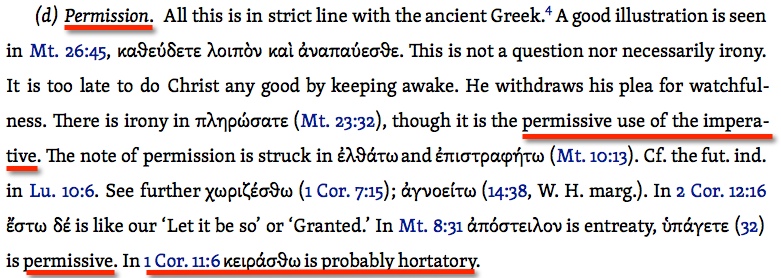
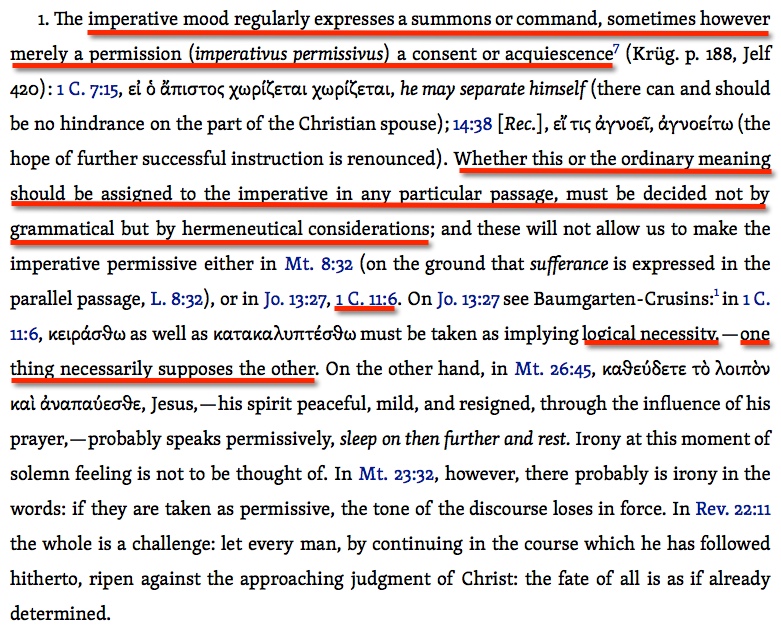
In the second part Paul gives two conditions. If it is disgraceful for a woman to have her hair cut or if it is disgraceful for a woman to have her head shaved, then she has permission to cover her head. (See Robertson’s grammar in the comment above regarding the permissive meaning).
Notice that Paul does not say that if a woman’s husband is disgraced in verse 6. In verse 6, Paul is talking about the woman’s shame. It is her shame that is given permission to be covered in verse 6.
In this passage, Paul is not talking about punishing a woman by shaving her head. He is just giving her permission to cover her head during prayer or prophesying, if she experiences shame. The logical necessity is to withdraw from the cultural requirement in total by cutting the hair, not by shaving the head completely off.
We need to note that the woman who has made a vow to God and has complied with God’s requirements by shaving off her hair when the vow is complete, is an honourable thing, not a dishonourable thing. It was obedience to God that caused the shaving, not a sign of shame.
LNE
2013-01-04
★
Thanks Cheryl, that was very edifying. I kind of figured that imperatives could sometimes be used in the permissive sense, since I had noticed certain imperatives logically seem like they must be only permissive in certain passages, but I did not know this was an established rule of Greek grammar, so it was helpful that you posted those excerpts from Robertson’s Grammar.
However, something said in the excerpt you posted has me confused again. It seems to say that the hermeneutical considerations will not allow making the “imperative (into a) permissive” in 1 Cor 11:6. It then says, I think, that the verbs for “let her have her hair cut” and “let her be covered” imply logical necessity.
Is this excerpt saying that “let her have her hair cut” is therefore imperative, something a woman must do if she does not cover her head? It seems like the writer of Robertson’s Grammar is saying that both of these verbs are used imperatively, not permissively, even though imperative verbs can be used permissively in other places (but not here according to what I’m reading from the excerpt.). I may be reading this all wrong, hopefully you can straighten me out.
Cheryl said:”The permission to have her head “shaved” is because there is no imperative whatsoever for shaving her head. In the first part of 1 Corinthians 11:6, Paul says “let her have her hair cut off”, but he does not say that it is a logical necessity for her to have her head shaved. The Greek words translated as “hair cut” and “shaved” are two different Greek words.”
Sorry, I mistakenly used the term “shaved” forgetting that there were two distinct terms for “have her hair cut”, and “shaved”. I meant “shaved” to mean the exact same thing as “have her hair cut off”. So my question was, is Paul telling uncovered women they should or must (imperatively) cut off their hair (or simply have their hair cut in some way) if they don’t cover their head, or merely that they may do so (permissively) if they want to?
Also, are the verbs for “to have the hair cut off” (keiro) and “to be shaven” (xurao) nearly synonymous, as it seems from the lexicons I’m reading, or does one mean something significantly different than the other?
Cheryl said: In the second part Paul gives two conditions. If it is disgraceful for a woman to have her hair cut or if it is disgraceful for a woman to have her head shaved, then she has permission to cover her head. (See Robertson’s grammar in the comment above regarding the permissive meaning).
I already asked this above, but it seems like Robertson’s grammar is saying the opposite, that both “let her cut her hair” and “let her be covered” are logical necessities, or imperatives, not permissive uses of the imperative in this case. Again, I’m no expert so I could be way off here, or maybe I’m just not understanding this excerpt properly.
Cheryl said: Notice that Paul does not say that if a woman’s husband is disgraced in verse 6. In verse 6, Paul is talking about the woman’s shame. It is her shame that is given permission to be covered in verse 6.
It is true that verse 6 is talking about the woman’s shame, but Paul does seem to be tying this to the shame of her “head” (her source, the man) from the previous verses, detailing that when a woman is uncovered, it is the same as being shaven, and she shames her head because of the “shaven head” for whatever reason.
It seems like if a woman shaves her head, she, as well as her husband at the same time, are shamed (in that cultural context).
Cheryl said: In this passage, Paul is not talking about punishing a woman by shaving her head. He is just giving her permission to cover her head during prayer or prophesying, if she experiences shame. The logical necessity is to withdraw from the cultural requirement in total by cutting the hair, not by shaving the head completely off.
We need to note that the woman who has made a vow to God and has complied with God’s requirements by shaving off her hair when the vow is complete, is an honorable thing, not a dishonorable thing. It was obedience to God that caused the shaving, not a sign of shame.
Are you then saying that Paul is telling women who don’t cover their heads to cut their hair, or merely recommending/permitting it?
God did tell those who took the Nazirite Vow to shave their heads. But Paul says the woman who is uncovered shames her head because she is as if shaven, and Paul equates the shaven head with shame. I don’t know why he does, but he does.
I’ve heard prostitutes of the era had shaven heads, and it was a punishment enacted toward adulterous women in Paul’s day, but I do not know what more to make of this. I’ve also heard that Jewish women were expected to cover their head, because it was seen as a private area. I believe Dr. Payne give references for the former two reasons being applicable during the time of Paul.
For whatever reason, Paul says the uncovered woman shames her head, because it was the same as being shaven. God tells women to cover their heads with something if a shaven head is shameful (perhaps He only permitted this, I don’t know yet), so God permitted women to shave their heads, but they should or may be covered while shaven if it is a shame to have an uncovered shaven head.
I see this as akin to what the previous chapter of 1 Corinthians ( 1 Cor 10) spoke about concerning not offending brothers and sisters unnecessarily, or anyone else if it can be avoided. I see this as something Paul either requires or permits because of mercy and the desire to avoid offense (and also his desire that man and woman submit to each other mutually for the others’ benefit, and honor each other above themselves, i.e. not shame each other if they can help it), not because a woman needs to show her submission by wearing a head covering as a symbol of the man’s authority over her (a Comp view).
Cheryl said: We also can know for certainty that “nature” does not teach a law regarding the length of hair on a man or a woman. Both are equally given hair that grows unless you cut it. This equal natural expression of hair was given to both by God Himself. God is not shamed by a woman without hair (as the rule of the Nazarite vow shows) and God is not shamed by a man with long hair (as the rule of the Nazarite vows shows). Paul was not forcing a veil on a woman so Paul was not upholding a man-made law.
I would like to agree with you here because it does seem that nature itself does not teach that a man’s long hair is a shame (since God commanded some men to have long hair, like Samson. Priests could not have long hair, nor shaven heads apparently, but we are not Levitical Priests.).
I have found that almost everywhere else in the NT where “oude” begins a sentence, as in 1 Cor 11:14, the sentence is declarative and not interrogative (a question). There are only three exceptions, all in The Gospels.
Paul never uses “oude” at the beginning of a sentence to introduce a question, from my study. Therefore, this supports the interpretation that verse 14 is not saying that long hair on men is a shame, nor that long hair is a woman’s glory. The only issue I have found with taking verse 14 as a declarative statement is that there is apparently a textual variant at the beginning of verse 14.
The variant is in the Textus Receptus and it is the little “n” or “or” particle, which often heads up interrogative rhetorical questions. I don’t know how many manuscripts, and which ones exactly, contain the “n” particle before the “oude” in verse 14, but if that particle is well attested then it does make verse 14 in all likelihood a question, supporting the idea that man’s long hair is a shame (which seems to be the traditional view). I have heard that the “n” particle that is part of the Textus Receptus here is not well attested and does not appear in any Greek critical text. Maybe you know more about this?
I’m hoping to have this cleared up, because your interpretation is the only one I think I have ever heard that remains faithful to the words in the passage and appears to me to be totally logical. I have always found Comp interpretations of this passage wanting, or based on mistranslations (1 Cor 11:10′s “a woman should have authority over her head”, made into the, in my opinion, utterly grammatically and syntactically improper ” a woman should have a [symbol of] authority on her head”, and the blatant mistranslation of verse 16, changing “no such custom” into “no other custom”, even though the word rendered “such” or “other” is from my research only known to mean “such”, never “other”. This subtle change of wording drastically changes the meaning of this verse.)
I thank you for sticking with me and answering these questions when I know you have other pressing business to attend to. I can only hope my apparent density will only be used by God to help those who read these comments to understand this passage even better.
 angie
2013-01-16
angie
2013-01-16
from my understanding physin natural is the cultural tradition.
 Cheryl Schatz
2013-01-16
Cheryl Schatz
2013-01-16
Sorry angie, I don’t understand your comment.
Cheryl Schatz
2013-02-13
I do believe that Paul was coming against human tradition that was not compatible with honouring our spiritual head (Christ). What did wearing of long hair do to dishonor Christ that was connected to the veil? I really do not know for sure. One other thing that could come into play is that women also used hair (in the form of a wig) to cover their heads. That would constitute a head covering just as much as a veil. Although it is a “natural” head covering with their own hair, it is not natural when it is a secondary source of hair as a wig. Wigs as hair coverings are discussed here http://en.wikipedia.org/wiki/Tzniut
Thanks for the discussion LNE. I think it was useful as iron sharpening iron.
Debate Points
Continuing our verse by verse through 1 Corinthians 11, we come to verse 6:
Your Tags
Personal labels you apply to any item — separate from system topics. Tags are shared across all databases. Visit /tags to browse all your tags.
...more
Personal labels you apply to any item — separate from system topics. Tags are shared across all databases. Visit /tags to browse all your tags.
...more