
Cheryl Schatz
2012-12-24
LNE,
In 1 Corinthians 11:6 there are two imperatives, with the second imperative functioning as a permission. Thus “let her cover her head” becomes a permission not a command. In Robertson’s Grammar the head covering is the permissive use of the imperative and is “probably hortatory” which is an encouragement.
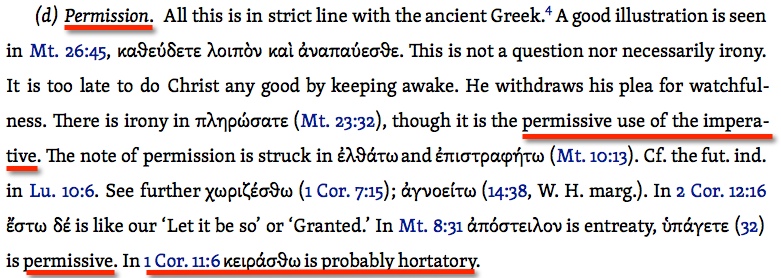
Regarding the first instance of a woman cutting her hair, the imperative must be decided not on grammatical considerations but by hermeneutical considerations. In this instance Robertson’s Grammar takes it as a logical necessity such that one thing supposes the other.
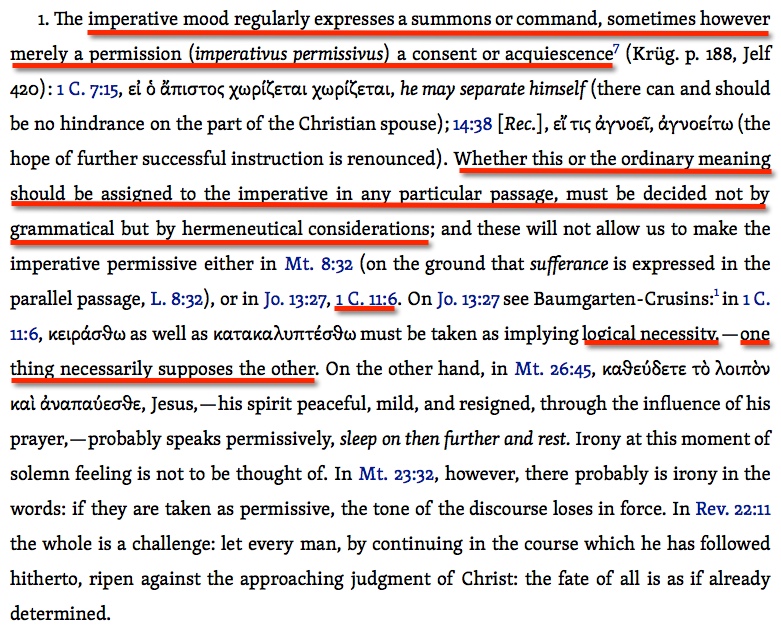
What does being free from the custom of covering one’s head presuppose? I would think that it would necessitate full freedom. So freedom from one binding custom is illogical if you keep the parallel custom of not cutting one’s hair. Either you are free and show it or you are bound. So with Paul it is either bound to culture or freed from culture but not half in/or half out. But at the same time, the decision to be in or out of the cultural mandate is left up to the woman. It seems from Robertson’s grammar that Paul strongly encourages women to see the issue as one cultural mandate, not two.
However Paul never mandates the head covering for the woman. It is a concession, a permission, that allows her to cover, but does not demand it. This is in agreement with 1 Cor 11:10 where Paul says that the women herself has authority over her own head.
I will respond further in the next comment.
Your Tags
Personal labels you apply to any item — separate from system topics. Tags are shared across all databases. Visit /tags to browse all your tags.
...more
Personal labels you apply to any item — separate from system topics. Tags are shared across all databases. Visit /tags to browse all your tags.
...more