Cheryl Schatz
Active 2008–2022
Tag Cloud
Thanks godrulz37!
allennelson4, welcome to my blog! You have several excellent questions. Let me answer this one straight up. It is impossible for the “I will give” from Jesus to be conditional on those the Father has preselected. It is also impossible that it is conditional on work. Let’s first consider the issue of work. Jesus told the unbelieving Jews that they needed to engage in an activity that involves effort. They needed to put forth an effort to gain eternal food. Now note, that Jesus says that He will certainly give them without qualification. He doesn’t say He will give them if they put forth the effort, and He doesn’t say that He won’t give the food to those who do not put forth the effort. He gives only a blanket statement that He will most certainly give them this food. See also verse 32 where Jesus is connected to the original Manna which was unconditionally given to all. In fact it only works as unconditional or the connection to the original Manna would be lost. You also asked if the certainty of the giving of the bread can be connected to the seeking from verse 26. No, it cannot be connected because Jesus promises to give them the eternal bread even though He goes on to tell us why they cannot believe in Him. The fact is that from the passage, The Giving is unconditional and promised to unbelievers. I will post more on the drawing and “coming to Him” and why this crowd is told that they cannot come to Him. But for now, The Giving is not connected to “the coming”, because Jesus promised to give unconditionally unlike the coming to Him which is conditional. Does my answer make sense?
I have shared the context of Jesus’ words, but if you are a Calvinist reading this blog and you disagree with my view, here are some questions that I would like you to answer from the context of John 6:44 – 1. Who did Jesus address His words to in John 6:44? If you disagree that Jesus spoke to the grumbling Jews concerning Him being the bread, then please show from the context, to whom Jesus was speaking. 2. What was the purpose of Jesus’ words to those that He was addressing these words? 3. In what way does John 6:45 relate to John 6:44? 4. In John 6:45 how many will be taught by God? 5. Why did Jesus respond with “It is written” in John 6:45?
LNE,
You also said:
what was shameful in the culture of Paul’s day, that the “covered” head of the man is long effeminate hair which Paul says is disgraceful for a man to have “down from the head”
This is impossible because of the Nazarite vow. God required a man who took a Nazarite vow to let his hair grow without cutting it until the vow was complete. God cannot say that a man with long hair who has taken a vow is a shameful thing and calling God’s rules as “effeminate” is a worldly attack on a man. God never calls long hair an effeminate thing nor can God sin by forcing a godly man who has taken a godly vow to do an ungodly thing. It just isn’t a Scriptural argument.
The thought that a woman’s hair must be kept wrapped up to be a “covering” doesn’t fit either with the Scriptures for nature cannot “teach” that it is an honor for a woman to have long hair and a dishonor for a man to have long hair. Nature teaches us that hair grows naturally on men and women until the hair is cut. God’s creation of the hair on one’s head is not different for a man and a woman in that one is naturally given short hair and one is naturally given long hair. Paul’s multiple levels of arguments are that it is not even nature that necessitates the length of one’s hair.
Lastly you said:
my question is still whether a woman is permitted to go without it, or is expressly told she must go all the way and have her head shaved
Check out the Greek carefully. There is no imperative of any sort about shaving the head. It is only conditional “if” the woman has shame if she has a shaved head, then she is permitted to wear the covering to cover her shaved, bald head.
Hopefully this has helped to answer your questions. Thanks for asking!
As far as why the head of a married woman was shameful but the head of an unmarried woman that was not covered was not shameful, Jewish tradition said that a married woman’s head hair was seen as a sexual part of her, not to be seen outside of her home. It was considered such a strict “law” that a woman could be immediately divorced if she was caught in pubic with her head hair uncovered. This was not God’s law, but it was a man-made law.
Also the quote from Wallace, it is only the one imperative that is stronger. The other imperative regarding head covering is not a command or a logical necessity.
LNE,
You also asked:
How is it proper to render this imperative verb as merely permission to have her hair shaved, as if it said “If a woman is not covering her head, let her also be permitted [but not commanded] to have her hair cut off”, and not as a command to have her head shaved (seemingly as a punishment for shaming her head [man] by not covering her physical head)?
The permission to have her head “shaved” is because there is no imperative whatsoever for shaving her head. In the first part of 1 Corinthians 11:6, Paul says “let her have her hair cut off”, but he does not say that it is a logical necessity for her to have her head shaved. The Greek words translated as “hair cut” and “shaved” are two different Greek words.
In the second part Paul gives two conditions. If it is disgraceful for a woman to have her hair cut or if it is disgraceful for a woman to have her head shaved, then she has permission to cover her head. (See Robertson’s grammar in the comment above regarding the permissive meaning).
Notice that Paul does not say that if a woman’s husband is disgraced in verse 6. In verse 6, Paul is talking about the woman’s shame. It is her shame that is given permission to be covered in verse 6.
In this passage, Paul is not talking about punishing a woman by shaving her head. He is just giving her permission to cover her head during prayer or prophesying, if she experiences shame. The logical necessity is to withdraw from the cultural requirement in total by cutting the hair, not by shaving the head completely off.
We need to note that the woman who has made a vow to God and has complied with God’s requirements by shaving off her hair when the vow is complete, is an honourable thing, not a dishonourable thing. It was obedience to God that caused the shaving, not a sign of shame.
LNE,
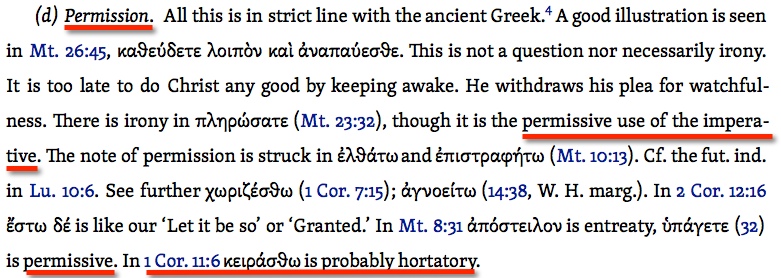
In 1 Corinthians 11:6 there are two imperatives, with the second imperative functioning as a permission. Thus “let her cover her head” becomes a permission not a command. In Robertson’s Grammar the head covering is the permissive use of the imperative and is “probably hortatory” which is an encouragement.
Regarding the first instance of a woman cutting her hair, the imperative must be decided not on grammatical considerations but by hermeneutical considerations. In this instance Robertson’s Grammar takes it as a logical necessity such that one thing supposes the other.
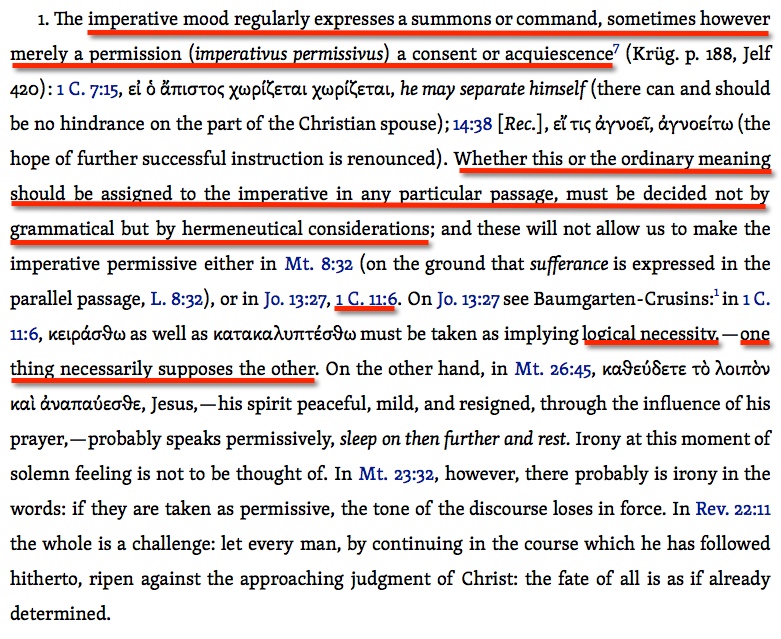
What does being free from the custom of covering one’s head presuppose? I would think that it would necessitate full freedom. So freedom from one binding custom is illogical if you keep the parallel custom of not cutting one’s hair. Either you are free and show it or you are bound. So with Paul it is either bound to culture or freed from culture but not half in/or half out. But at the same time, the decision to be in or out of the cultural mandate is left up to the woman. It seems from Robertson’s grammar that Paul strongly encourages women to see the issue as one cultural mandate, not two.
However Paul never mandates the head covering for the woman. It is a concession, a permission, that allows her to cover, but does not demand it. This is in agreement with 1 Cor 11:10 where Paul says that the women herself has authority over her own head.
I will respond further in the next comment.
Excellent questions LNE! Your questions deserve an in-depth answer that I think you will find has been well thought-out. I will get to it as soon as I can during this Christmas season.
Another note is that I am having to upgrade the WordPress on this blog and it is not compatible with the Theme that I have chosen so there may be some issues to work through. Hopefully things will not be “broke” but will go smoothly.
Here is the caption again smaller width so that hopefully it fits in the column. If not just right click to copy to save the jpg onto your computer.

Thanks Christian for that information and welcome to my blog!
I looked up the quote and here is a screen print for those who are interested.
[caption id="attachment_2624" align="aligncenter" width="877" caption="Eis from BDAG lexicon pg 292 on WIM by Cheryl Schatz"] [/caption]
Welcome back, Derek! I was sick with the flu this week so didn’t finish the next post but it should be up sometime this coming week. Now to your question. Drawing in this context means teaching. Is teaching co-operative? Well, I would say that there are not 2 teachers but there has to be a student who does something with the teaching. That would be where the next verse comes in. God finishes His point that there is a response needed. There can be times when God does not want a response. When that happens he puts people to sleep. i.e. He put Abraham into a deep sleep and He made a unilateral covenant without Abraham responding. Is this what you are looking for?
John 6:45 (NASB95) 45“It is written in the prophets, ‘AND THEY SHALL ALL BE TAUGHT OF GOD.’ Everyone who has heard and learned from the Father, comes to Me. I will be going on in this passage very carefully through the important words and grammar. We need to see the big picture, but we also need to see the minute details that God wants us to see. To understand the passage we need to know what the words mean. That is the presupposition that I come to any passage with. What has God said and why did God say it? I believe that God makes Himself clear if we are willing to learn from what He has already said.
Thanks Derek, I am just feeling like my old self now. That made me really behind so I am scrambling to catch up. I have the next post mostly done and it will explain in detail who Jesus to talking to, why He said the things He did, and How He fulfilled God’s prophecy. I think when you read it, it will make a lot of sense. I believe that we need to strive hard to see what God has already said in the context rather than adding to the context. The reason is that when we add our own ideas to what God has said, we can really go far off in left field. We don’t need philosophy to answer these questions, just a good nose to stick into the text and keep it there until we understand. That is my two cents anyways. 🙂
godrulz37, It is fairly obvious if you follow Jesus’ words through. I won’t explain it here because I have already done that in my next article. I will get it finished as soon as I can. I think it will help to make it clear why Jesus said what He did to the Jews.
Derek, I don’t mind that you think I am reading into the text. I think that after you read the next article, you will see that I am not. I am only pulling out what is already there. After all when Jesus uses the word “draw” He needs to tell us what He means by it, right? If He explains, then we need to pay attention. I am finishing our next newsletter for our ministry that has to go for set up and then printing this coming week so that is my first thing to get off the list and when I am finished, I will get the next article finished as well and post it. If anyone is interested in receiving a free online version of our MM Outreach News & Views in the world of religion, we did give one edition for free for evaluation. Just send me an email that you would like a copy and I will put you on our list.
That should be “We do give a free evaluation issue” Present tense not past tense.
By the way, I always feel flattered whenever people say to me that I pay too much attention to the text. I believe that when it comes to the hard texts, we so often don’t pay enough attention, so I am happy when people see that I do pay attention. So I would like to offer a challenge on this text. Read it and meditate on it and keep reading until you can figure out what Jesus exposes is the meaning that He is giving to “draw”. Don’t go to a commentary! Just read God’s for Word for yourself. Read. Meditate. And pray. There is much meat in the text that we just buzz over and don’t stay in long enough to really understand what is being said. And then I will post my next article next week and see if it comes close to what you already figured out for yourself.
Thanks Godrulz37!
I do have strong opinions on these areas, but will leave this until I bring up the Scriptures in other articles. Good areas for discussion.
godrulzz37 Thanks for your kind words! It seems to me that principles are based on what God has already said, thus knowing what God has said is highly important. I don’t think Ryan has had time to read my response. Does a verse have multiple interpretations? I believe that we must research the words and grammar to understand what God has written and doing that will make any “alternate” interpretation fall away. That is why questions like Ryan brought out are very important. When we deal with questions head on and study diligently to answer, this will either bolster our view or make us re-evaluate what we believe. I think this is a win-win proposition. It is why I appreciate questions and challenges. They allow me to become stronger in my position or change my position. The issue of babies going to heaven because they are part of humanity whom Christ died for is legitimate. But for most of Calvinism, this is not part of their theology for Christ only died effectually for the elect. To allow babies to be saved, in that view, must mean that all dead babies are pre-elected unconditionally from eternity past. That would also mean that no un-elect baby is allowed to die. Or one is stuck with unborn babies going to hell and suffering which is not the position that Jesus took when He welcome all children to Himself. The character of God is a big part of the answer one brings to the table. As far as “original sin”, I do not believe that a person is charged with Adam’s sin that is passed on to his offspring, but I do believe in a sin nature known in scripture as the “old man” is passed on through Adam and it shows itself as a natural tendency to rebellion and sin. I wrote a piece on this on my other blog here http://strivetoenter.com/wim/2006/11/20/adam-as-head-of-the-family/ This article explains the necessity of the virgin birth because of the sin of rebellion of Adam. As far as the Augustinian view of original sin, I have not read his writings, so I can’t comment on his views. The Catholic view does not match with the Scriptures so I would reject what they teach about baptism and babies. I hope this helps. I am working on two other articles on the Lamb’s book of life. The first one will be who is in the book of life and the second article will deal with Rev. 17:8 regarding whose name is not written in the book of life from the foundation of the world. I hope the articles will be thought-provoking.
godrulz37, Forming a nature as we sin, doesn’t account for the “natural” sin nature of even young children who do not need to be taught to lie.
It also doesn’t account for the importance of Jesus not having a human Father. If there was no rebellion inherited through Adam, then Jesus could have had a human Father and still been the Son of God. I am unconvinced of any argument that makes Adam’s sin irrelevant to us.
godrulz37, You said: Adam’s sin is not irrelevant because it introduces sin and death into the human race. Would it be fair to say that Adam’s sin passed on a physical decay to all of Adam’s seed? That this decay (the fact that we are born dying and with a limited time here on this earth) is passed on to all of us through Adam? I realize that Adam and Lucifer both sinned without a sin nature, but they both sinned willfully and with full knowledge, and the rest of us started to sin when we didn’t even know what sin was. We have a propensity to sin that cannot be explained by the way God created us. This is the reason why God treated Lucifer and Adam so harshly. They were traitors because of their sin. But a young baby who has never understood what “a lie” is naturally acts in a way contrary to the way God made us to be. I also want to make it clear that I do not believe that we inherit “sin” from Adam. A “sin nature” is not sin. Adam is responsible for his own sin and we are responsible for our own sin. I do not believe that Jesus was born of Mary so that He was not born a sinner, but without a sin nature. If you read the link I gave you it has charts that explain what I believe. I won’t go into it here as that would be redundant. i have a great deal of compassion for people who struggle through this issue. I just want to encourage people to see what God says on an issue. What are His exact words and His grammar and why does He say what He says? I hope this helps!
godrulz37, You said: I agree we have a propensity to sin, This is the sin nature that I am talking about. However when God created humans there was no “propensity to sin”. Both Adam and Eve were created in God’s image and the propensity was to be like God in morality. We can no longer say that. In fact that Bible predicts that all of us sin even though most of us were not created at the time it was written. It is because God’s original creation with the propensity to morality was broken down by sin and the propensity to sin is an addition to what God originally created. If we can agree on that, then it doesn’t matter what we call it, we both accept that we will all sin because we have something that God did not create within us. And praise God, one day that propensity to sin will be destroyed and we will be back to the morality that God intended in the first place. I SO look forward to that day! Thanks so much for your gracious attitude in this discussion. I am used to people taking a strip off of me from left to right and then back again. It is a blessing when Christians can discuss these issues and still consider one another worthy of Christian charity!
So the logical bottom line question would seem to be, are we the same morally as before Adam sinned? Or did God create us to be naturally moral beings? I don’t think I know anyone who would think that we are exactly the way Adam and Eve were when they were first created. And I also don’t know anyone who would say that we will be this way in heaven. The change seems to be in which side of propensity we exist. Morality or sin? I believe very strongly that we will have zero propensity for sin in heaven even though we will still be human.
Derek, I have posted my comments on babies and Jesus comment about Judas dying before he was born on my new post at http://www.mmoutreach.org/tg/babies/ We can carry on discussion there and I will pursue the clarification/summarization of your views at a later date.
Excellent questions, Ryan! The Greek word that Jesus used is highly important. It refers to something that is actually good, not “less bad”. If Jesus had wanted us to know that Judas would have been punished in hell as a baby, but not as much as he would have been punished as a grown man who betrayed Jesus, then He would have used a word comparing judgments, not a word identifying a good thing. For example in Matthew 10:15, Jesus said: Matthew 10:15 (NASB) 15 “Truly I say to you, it will be more tolerable for the land of Sodom and Gomorrah in the day of judgment than for that city. The term “more tolerable” is a comparison of judgment. It is not “good” or “beneficial”.
Hi Derek, Ah, two commenters to keep up with. Great! No, I do not believe that David was just saying that he was going to die. I believe that the words used as written for our benefit and are inspired. David said that “I will go to him”. He didn’t say that “I will die too”. These inspired words follow the words that the baby will not come back to life to be with David, but that David is comforted that he will go to his son. This is the explanation that David gives for the question about why he has washed himself and is eating. David is assured in his heart that he will see the boy again and so he takes comfort in his God who takes the innocents to Himself. If David was only saying that he too would die, then that would be no reason to wash himself and eat. It would be a negative saying not a positive one. And the fact that David worshiped the God who holds his son, shows a confidence and faith in God that He is a God of justice and mercy. It reflects the words of Jesus who also said that kingdom belongs to children.
Ryan, your next question is also excellent! You said: Further, would it be possible that Jesus is saying here that it would have been better that Judas had never existed, not that he died before or at birth? If Judas had never existed, there can be no advantage for him for there would be no person to exist to have an advantage.
Ryan, You asked: Further, we might only be able to conclude from the passage in Jeremiah that those ‘innocents’ were innocent of the sins of their fathers. Is this a strong enough statement to conclude on its own that babies are innocent of all sin? Really, really good question. The Bible gives evidence that God does not charge the son with the sin of the Father, yet the son may not be considered innocent. Deuteronomy 24:16 (NASB) 16 “Fathers shall not be put to death for their sons, nor shall sons be put to death for their fathers; everyone shall be put to death for his own sin. Also the term used for the innocent children means blood free of blame: