Browse / Scripture Commentary / Article

Submission And Origin Of Authority

2010-06-02 commentary Cheryl Schatz

When is authority given and when can it be rightfully assumed. These are questions that have divided egalitarians and complementarians in the area of marriage

Date: 2010-06-02
URL: https://mmoutreach.org/wim/2010/06/02/submission-and-origin-of-authority/


Authority given on Women in Ministry by Cheryl Schatz

When is authority given and when can it be rightfully assumed?  These are questions that have divided egalitarians and complementarians in the area of marriage.  While egalitarians generally will agree that submission is a characteristic of Spirit-filled Christians who love and respect the body of Christ, and who serve each other with love, complementarians say that husbands are never commanded to submit to their wives because husbands maintain a God-given sphere of authority that requires sacrifice and not submission.  To a complementarian, submission is always something given to an authority.  Since they don’t believe that a wife has authority over a husband they refuse to submit to their wives.  Is this Biblical? 

In order to refuse submission as a Christ-like action and/or attitude of both spouses in marriage, they must reject that the reciprocal “to one another” in Ephesians 5:21 really does mean “one to another”.  Instead, they are forced to interpret the inspired reciprocal and change it to mean “some to others” as in “Christians who are subject to authority” are to submit to “those in authority”.  This makes it a one-way submission and it adds the condition of authority when no such condition exists.  It also noodles with the inspired text to remove the inspired reciprocal nature of the term to one another.  This is one of the weak links in the complementarian argument.

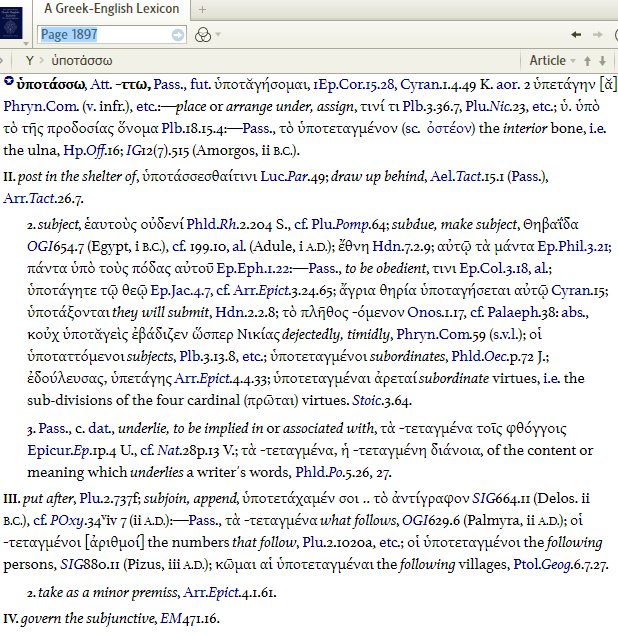
First of all let’s prove that Ephesians 5:21 has the reciprocal. Note the screen print below of the Greek and the reciprocal grammar:

reciprocal on Women in Ministry blog by Cheryl Schatz

If God had meant that Christians are to submit to authorities in the church, then why didn’t God God just say it like that in Ephesians 5:21 like He did in Romans 13:1?

Romans 13:1 (NASB) Every person is to be in subjection to the governing authorities

Note that in Romans 13:1, the ones to be under submission are clearly noted as “every person” and those to whom they are to submit themselves to is ” the governing authorities”.  Romans 13:1 is clearly about the requirement for all to submit themselves to the secular governmental authority. But Ephesians 5:21 is not like the one-sided submission of Romans 13:1.  Rather Ephesians 5:21 makes the submission linked to mutuality.

Some may say that the three groups that follow verse 21 are examples of one-sided submission so verse 21 cannot be reciprocal.  But we cannot allow our bias to distort the clear word of Scripture.  The most important issue is that it is God who said the submission is to be reciprocal by His inspiring Paul’s words and grammar.  Secondly God supported this reciprocal nature of submission in chapter 6.

Ephesians 6:7 (NASB) With good will render service, as to the Lord, and not to men,

The Greek term for “render service” means to be a slave, serve, subject oneself (active) and further to act or conduct oneself as one in total service to another.  See below the subjection (submission) that is part of the “service” that is given from the slave to the master.

Ephesians 6:7 on Women in Ministry blog by Cheryl Schatz

Paul goes on in verse 9 to present the reciprocal nature of the submission:

Ephesians 6:9 (NASB) And masters, do the same things to them, …

The same things that these Christian masters are to do is what their slaves were to do for them.  Their slaves were to be subjected to them and serve them. God shows that the masters are to do the same.

This is the Christian doctrine of mutual submission. The submission is not just for slaves but for their masters too!  In the same way, husbands are to be a part of mutual submission and they are not a special class that is exempt from Christian submission.  (Eph. 5:21)

So what does this mutual submission look like in practice between husbands and wives, parents and children and slaves and masters?  It isn’t hard to envision.  It is two-fold submission that is expressed in willing service.  Submission is also expressed as a willingness to receive God’s gifts through the other brother or sister in Christ.  Let’s see this submission in action:

  1. A wife has a busy day and needs to put together a meal before she leaves for her Bible study when she realizes that she forgot to purchase milk for the children. When her husband comes in the door, she asks him to go to the store to pick up the milk for the meal.  Her husband willing submits to his wife’s request.

  2. A Father tired after a long day lays back in his easy chair to relax after dinner when his four-year-old son asks him to read him a bedtime Bible story. The Father submits to the request of his young son and goes to his son’s bed to read him a Bible story and tuck him into bed.

  3. A servant has a teaching from the Scriptures that he will be giving to the congregation and his master submits to learn from the teaching that his own servant brings.

Notice that in all three examples the one who submits himself to the other one is not obligated to submit because the other person has authority over him. Rather he submits because it is the right thing to do. It is a Christian humility that puts himself under another person’s need or the submission is given to the brother or sister in order to receive a gift that the other person has for them. This is the face of reciprocal submission.

But most complementarians cannot even think about submission without re-defining submission as a response to an authority that is over them. But is Christian submission as defined by Ephesians 5:21 really to be assumed as an attachment of a God-given authority even though God never says that? Are we really to assume that God gave masters their authority over their slaves? The fact is that this reasoning was rejected a lot of years ago as a man-made system that was never authorized by God. So is the authority that husbands believe they have over their wife a God-given authority? Like the authority of the master, the authority of the husband is also never established by God.

So what is the unique authority that complementarians say that the husband has been given over the wife? Complementarians are not  in agreement over the extent of the authority. Some say that husbands have the final say in every decision of the marriage and home. Others add that the husband’s authority is to love his wife and sacrifice for her. However, they can’t seem to explain how the husband’s authority is not also the wife’s when she loves and sacrifices for him.

What I would like to do is challenge complementarians to give a Biblical example of the one-sided submission that they believe must be given by wives to their husbands but is not allowed for husbands to do for their wives (i.e. a non-reciprocal submission)?  Let’s have a look at your examples and discuss the Biblical passages that originate that type of submission.

I will give the first example as one that Mark gave in the comment section on the last post.  Mark said:

Gal 5:13 is a prime example of the husbands role as husband. The husband is called to love his wife like Christ did the Church. IN Gal we are told to ‘through love serve one another’, so yes i would through love serve my wife.

I ask, what kind of love is the husband called to give that is not allowed for his wife to love him back in the same way?  What kind of service is not allowed for a wife that is only allowed for a husband?  In what way is this a role that is unique to a husband and where does the authority come from to command an application of a service to apply solely to the husband?

Thoughts?

TL 2010-06-03

Being in the state of subordinate, rather than setting oneself in the position of controller is this word….

uJpotagh/, hvß, hJ (s. tagh/, and cp. 2 aor. of uJpota¿ssw; Dionys. Hal. 3, 66, 3 act. ‘subjecting’) in our lit. only pass. the state of submissiveness, subjection, subordination, as opposed to setting oneself up as controller (Plut., Mor. 142e) (Wsd 18:15 A; TestSol; ApcMos 10; Artem. 1, 73 p. 66, 14; Paradoxogr. p. 218, 7 Westermann e?n uJpotaghvØ; Vett. Val. 106, 8; 11; 17; 24; 198, 28; BGU 96, 7 [III BC] ton e?n uJpotaghvØ tugca¿nonta. Cp. e?n uJp. me÷nein touv qeouv Iren. 4, 38, 3 [Harv. II 196, 3]; Theoph. Ant 1, 6 [p. 70, 11]). hJ uJpotagh thvß oJmologi÷aß uJmw?n ei?ß to eujagge÷lion 2 Cor 9:13 (oJmologi÷a 1). e?n pa¿shØ uJpotaghvØ subordinating herself in every respect 1 Ti 2:11 (cp. cum omni subiectione Papias [1:3]); te÷kna e¶cein e?n uJpotaghvØ keep children under control 3:4. e?n mia?ˆ uJpotaghvØ kathrtisme÷noi made complete in unanimous subjection IEph 2:2. ei¶xamen thvØ uJpotaghvØ (dat. of manner) we yielded in submission Gal 2:5. The system of ordered relationships requires recognition of one’s proper place in the structure. Since Paul is {p. 1042} subordinate to the ‘truth of the gospel’ he cannot comply with some demands imposed by leaders in Jerusalem who have the obligation to recognize their place in the order of things.—Of the members of the body uJpotaghvØ mia?ˆ crhvtai they experience a mutual subjection 1 Cl 37:5. oJ kanw»n thvß uJpotaghvß the established norm of obedience (Kleist) 1:3.—DELG s.v. ta¿ssw. M-M. TW.

I’m just learning how to use my new Accordance software, but I did manage to find this. The above word is upotauh (I think). It describes a sort of involuntary state of being, something like what Charis is interpreting the Ephe. 5:24 passage. But as we can see, this is a different word than the one in discussion which is upotasso(menoi).

gengwall 2010-06-03

Just the perseus site

Kay 2010-06-04

LOL, gengwall.

Mark 2010-06-06

Ok just saw this thread and will offer a few comments, although i can’t commit to hanging around becasue i am busy for the next few weeks.

First, we are all under authority. I don’t know how important we must stress this point.

Second, why is a wife under her husbands authority? I’m surprised at this really. The best answer is to look at the Bible. Ephesians 5 teaches us that the wife must submit to her husband as the church does to Christ. Now from the threaded comments, most assume this means that a wife has no choices or options- that she is just ‘property’ i saw someone write. But is this the way we view our selves as Christ’s bride? Surely not! I think the answer you look for is bound up in the comparison Paul draws. The church is cherished, loved, sacrificed for. She is free to accept and follow Christ as her head or she is free to reject Him. Likewise a wife is free to follow her head or reject him. She is not just property, but someone cherished, loved and sacrificed for. If egalitarians stop slandering the comp position as much as you criicise them doing it to you that would help.

Finally, the single woman issue is an important one and i’m not sure i can offer an appropriate pastoral perspective. All i can say is that marriage and family are important. God created this world in order that we might multiply and subdue it. God ordained marriage as a reflection of the covenant relationship of Christ and the Church. Marriage is extremly important and beautiful. Anyone blessed enough to be married ought to cherish it and understand how this ‘one flesh’ union reflects the beauty of us as Christ’s bride.

I guess the obvious point is that singleness in women was not an issue in the New Tetament era, so it’s hardly surprising that no instruction is given on the issue. That is why we must do our best to try and grasp and understanding from other areas in the Bible and apply them today. Again it is not helpful to criticise pastors or churches who attempt to give some instruction on this issue. We must not import our 21st century society back into the Bible and demand answers as we wish. It is not a flaw in the comp position, in as much as it is not a flaw in the egal pos. Neither can offer direct biblical teaching on the issue.

Cheryl,

as to your 3 examples in your thread, be careful not to confuse submit with service. Again here are the two definitions.

Serve- “perform duties or services for”

Submit-“accept or yield to a superior force or stronger person”

So when a husband goes and buys milk, is he serving or submitting? This is the fundamental difference, and egalitarians should stop confusing the two (or combining the two). When a father reads his child a sory after being asked is he submitting or serving? If you wish to keep using the term submit, you need to give a definition as to why you reject dictionary entries for this word and remove authority from it. This is an important point since egalitarians wish to continue to emphasise that a husband must submit to his wife, yet they are ignoring the very definition for submit. This became clear for me with Dave’s comments- since the whole egal system is built on mutual submitting, but the verb submit is rdefined from it’s biblical use and it’s modern english meaning.

Cheerio

Kristen 2010-06-06

Mark, I’m very surprised that you wrote this:
“I guess the obvious point is that singleness in women was not an issue in the New Tetament era, so it’s hardly surprising that no instruction is given on the issue. That is why we must do our best to try and grasp and understanding from other areas in the Bible and apply them today. Again it is not helpful to criticise pastors or churches who attempt to give some instruction on this issue. We must not import our 21st century society back into the Bible and demand answers as we wish. It is not a flaw in the comp position, in as much as it is not a flaw in the egal pos. Neither can offer direct biblical teaching on the issue.”
It seems to me that it is in ignoring single women that we are importing our 21st-century church society back onto the Bible! Paul specifically wrote in 1 Cor. 7 how a woman who chose not to get married was blessed, how she had chosen single-minded devotion to the Lord. Around these and similar words of Paul’s, the early church quickly came to honor virginity more than marriage. Within 50 years after Paul’s letters, Christians were aspiring to virginity as the “best” way to serve God. Out of this rose the “virgin martyrs” — women who resisted the Roman law that women had to marry, choosing to remain virgins for Christ and losing their lives for it. These women were honored up till the time of Martin Luther, who rightly corrected the over-emphasis on virginity, affirming marriage as just as blessed a state.
But recently, starting about 1990, there has been reaction in the church against perceived feminist influences, resulting in an insistence that a woman’s proper role is to be a wife and mother. There has been a devaluing of the blessed state of singleness, particularly in women, as a state in which she is uniquely empowered to serve the Lord in special ways that marriage will curtail in her life. Young women are taught that they are “brides in training” and encouraged to focus their energies on learning the skills to one day be a good wife and mother.
This, I really have to say in support of Paul and his much-needed, balancing passages on the blessings of being single, is an over-emphasis on marriage just as potentially destructive as the early church’s emphasis on virginity.
But the New Testament most assuredly does address single women! It our 21st-century evangelical churches who are making them feel like second-class citizens.

Cheryl Schatz 2010-06-06

56 Mark,

You said:

First, we are all under authority. I don’t know how important we must stress this point.

We are under God-ordained authority of the government. However God has never ordained an authority of the husband over the wife. Authority cannot be assumed. It must be given.

Second, why is a wife under her husbands authority? I’m surprised at this really. The best answer is to look at the Bible. Ephesians 5 teaches us that the wife must submit to her husband as the church does to Christ.

So you are saying that a wife must be under her husband’s authority because she is to submit to him? The problem with this reasoning is that her submission is never said to be submission to authority. And he is never given authority over her. It is a key point that authority must be given. Authority is such an important issue that it cannot be assumed to exist for resisting authority and disobeying authority brings punishment. Thus because authority has a responsibility regarding punishment, it cannot be assumed but must be given by God.

Authority of a husband over his wife fails every test of legitimate authority. It is never directly given by God to a husband. A husband can never legitimately “punish” his wife for not obeying him. While a government can “punish” its citizens for not obeying and a government can enforce obedience, a husband can do neither. Any “authority” that is taken by the husband is cultural and is not God-given. In our free countries a husband can be held accountable for “punishing” his wife for not obeying him. He can also be held accountable by the courts and by the law for forcing his wife into obedience. Only in non-free lands where the culture gives unilateral authority to the husband can he practice his “authority” over her without impunity.

What kind of God-given authority does a man have that has no power over his wife to force her to obey or to punish her for disobedience? God-given authority always has power and the right to punish. It is only in pagan lands where the culture is not godly that the husband has full authority over his wife. In Christian lands, the husband does not have this power or authority that he can enforce on her. There is no evidence that the husband has a God-given authority over the wife.

Cheryl Schatz 2010-06-06

Mark #56,

To continue from your comments.

Now from the threaded comments, most assume this means that a wife has no choices or options- that she is just ‘property’ i saw someone write. But is this the way we view our selves as Christ’s bride?

Mark, we are not denying the need to have willingly submission to serve Christ and to receive from Him the gifts that He wants to give us. The issue is whether the husband has a legitimate authority to command submission or if the authority that is claimed belongs to the husband is one usurped from Christ.

Wives then give willing submission to their husbands because they love them and want to serve their needs. In what way would authority even be needed in the human relationship? What “rights” belong to this authority? Since God never delegated an authority to the husband, what “rights” would go along with an un-given authority?

We know that the husband has the right over his wife’s sexuality because that is clearly given along with the wife’s right to her husband’s sexuality. That is why neither one of them has the right to have a physical relationship with another person because that right does not belong to them to give away. But what “right” does a husband claim to have that is never given to him in the Scripture? Since authority goes along with “rights”, it is amazing that husbands can swallow the idea that they have authority over their wives when Scripture never tells them what “rights” they have that are not also given to the wife.

Mark 2010-06-06

Cheryl,

First i want to agree with something you said. I agree that for a person to submit it is a voluntary action. This is why Eph 5 is so crucial. I as a husband do not ‘demand’ my wife to submit. In her walk with Jesus she believes she is told to submit to me her husband. It is something God requires of her not me. So i agree that submission is a voluntary act.
However, why do you assume therefore that authority cannot exist? Why is it, that you actually contradict the meaning of this verb? Just saying it is a voluntary action is nothing spectacularly enilightening. You have jumped from voluntary to therefore not under authority, which is a complete reversal of it’s use in the Bible.

do you believe Church leaders have authority over you? Do they force you to obey and punish you as you describe?

The problem again seems to be that authority equals ‘demands’ or ‘forcing’ something in your view. You are using words that overstate both what comp teaches and what submission means. You need to show me how submitting voluntarily therefore means that authority is irrelevant since this seems to be the crux of your argument. Please stay away from words (all egals) like tyranny, force, demands, abuse, etc etc. It’s simply evidence to me that you are trying to criminalise the comp position to say stuff it isn’t. Ironic how egalitarians do the same things they accuse many comps of doing. I guess that’s the nature of debates though, right?

I’ve run outta time…

Cheryl Schatz 2010-06-06

Mark #56,
You said:

The church is cherished, loved, sacrificed for. She is free to accept and follow Christ as her head or she is free to reject Him.

Actually a Christian is not free to reject Christ’s authority. But we are given the opportunity to serve Him (freely) and to receive all that He gives us including His wisdom that allows us to make our own decisions that are wise. But there is punishment that comes to all who reject Christ’s authority. Where is the punishment that is allowed for wives who reject their husband’s authority? Are we really going to give the authority of God to the husband that would allow him to have power over and punish his own wife?

If egalitarians stop slandering the comp position as much as you criicise them doing it to you that would help.

Egalitarians do not slander the comp position regarding our position in Christ. But egals challenge the comp position where an authority is ascribed to the husband that would give him the “rights” of Christ to her. We continually claim that Christ has an authority that is not mimicked by the husband and Christ has a “rule” and “rights” that are not given to the husband. And those who submit to a “rule” of the husband may well be in danger of idolatry.

I guess the obvious point is that singleness in women was not an issue in the New Tetament era, so it’s hardly surprising that no instruction is given on the issue.

Actually that is not true. There were many widows in the church and their singleness was a very big issue in the church. There were instructions on the support to be given to widows but no instruction was ever given regarding who was to be in “authority over” these single women. Instead they were free to served the Lord without a personal “ruler” over them.

Cheryl Schatz 2010-06-06

70 Mark,

You said:

However, why do you assume therefore that authority cannot exist? Why is it, that you actually contradict the meaning of this verb?

The meaning of the Greek verb does not force authority before one can submit. Look again at my comment #2. Now think about this. Is Paul using “submit” in a military way regarding relationships? He cannot be using it this way because it would be nonsense. You have not yet answered the specific grammar of reciprocity in the verb “submit”. All you have done is to try to use “reason” to deny it. That is because when you start out with the wrong meaning for a word that says that one must be submitting to an authority or power over them, it makes no sense to tell a master to submit to his slave. But the fact is that Ephesians 6 tells master to do to their slaves what their slaves are to do to them. It is reciprocal in nature because Paul is not using an authority base. We can understand that the slave has no authority over the master so the submission is not possible to be authority based. But the fact that the master is to act in a reciprocal way shows that Paul is talking about respectful Christian behavior not about authority based authority. Thus we can submit to our children’s needs even though they don’t have authority over us. And husbands can submit to their wives needs even though they don’t have authority over their husbands.

Just saying it is a voluntary action is nothing spectacularly enilightening. You have jumped from voluntary to therefore not under authority, which is a complete reversal of it’s use in the Bible.

Ephesians 6 blows this out of the water. To argue that submission is always because there is an authority is made nonsense by Paul’s requiring masters to do for their slaves the same things that their slaves are required to do for them. How complementarians can ignore the very next chapter really does mind-boggle me. They are sometimes so “authority” minded that they are no “earthly” good.

do you believe Church leaders have authority over you? Do they force you to obey and punish you as you describe?

Church leaders have no God-given authority over individuals and this is why it is the church themselves that are to discipline those who are sinning. It is the body that has authority. No church leader can demand submission. This is why we are told to submit to them willingly so that their work is not a grief since they are to watch over us to protect us. They can’t protect us if we refuse to submit.

The problem again seems to be that authority equals ‘demands’ or ‘forcing’ something in your view.

This is the accepted meaning of authority. In fact the very first definition of authority means:

the power to determine, adjudicate, or otherwise settle issues or disputes; jurisdiction; the right to control, command, or determine.

What does God’s authority mean? It means that He has the power and the right to control and to command and for dissenters He has the right to punish. What would authority mean if God had no right or power to enforce His authority? The fact that He has the power and the right to demand and then punish proves that He has legitimate authority. Where is the husband’s legitimate proof of authority?

You are using words that overstate both what comp teaches and what submission means.

Again submission is not the difference between us but it is the authority that is the difference. We submit in love to one who cannot demand our submission. Your position is that the wife submits in love but her submission is also to one who has the right to take authority over her will should she not submit willingly. He then has a “right” to make a decision without her submission. This is where we depart ways.

You need to show me how submitting voluntarily therefore means that authority is irrelevant since this seems to be the crux of your argument.

First of all there is no authority needed if the submission is voluntary. Secondly there is no authority ever given by God to the husband over his wife so we insist on legitimate authority not illegitimate authority that is a usurping of God’s authority without His permission. Since you have shown no evidence to prove that God has given husband’s God’s delegation of authority, how is it that I am to respond to a relevant authority argument when no such authority has been established? I have been arguing that proper God-given authority has “teeth”. It has the authority to punish disobedience. Yet comps appear to teach an authority with no “teeth”, which is a clear indication to me that such “authority” is not God-given.

Please stay away from words (all egals) like tyranny, force, demands, abuse, etc etc.

Fine. I just did. I have shown that there is no “authority” given to the husband that would allow for punishment of non-compliance. If this was true authority, it would be the only authority that I am aware of that has no “teeth”. Not a good sign at all, my friend.

I’ve run outta time…

I do hope that you are able to come back to answer my questions and especially to show your view of comp submission. I have given you an egal understanding of willing submission of one to another without authority that would by the very nature of an authority demand such submission. What I would like to see from you is examples of wifely submission to her “authority” that are not things that a husband would ever do for his wife. What are such unique acts of “submission to authority” life in your viewpoint? I would love to see them.

Thanks for your consideration.

Cheryl Schatz 2010-06-06

Okay, back to answering Mark from #56,

Again it is not helpful to criticise pastors or churches who attempt to give some instruction on this issue. We must not import our 21st century society back into the Bible and demand answers as we wish. It is not a flaw in the comp position, in as much as it is not a flaw in the egal pos. Neither can offer direct biblical teaching on the issue.

I think that it is valid to criticize pastors and churches who create rules that are not based in the Bible. When single women are instructed to find a church leader to take the position of “head” while she is single, this is going beyond the Scripture.

The issue again is whether a woman needs a man to be in authority over her? If she needs this, then a single woman would have to be looking for someone to take authority over her and to make her decisions when there is disagreement. But the Scripture never assigns a head/body relationship for a single woman. She is never told that she needs to find a “head”. She is never instructed to be under the authority of a man or that she has a need of an authority. Rather it is said that she has freedom to serve the Lord as she is. When complementarians go beyond the Scripture to carry on the myth that women need an authority, they actually harm women who can become convinced that they are not to seek for maturity, but to seek for a man as authority.

as to your 3 examples in your thread, be careful not to confuse submit with service. Again here are the two definitions.

Serve- “perform duties or services for”

Submit-“accept or yield to a superior force or stronger person”>

First of all the definition I was giving for submit was to submit to the other person’s need. While service is a way to submit to the other person’s need, it goes beyond service. They are not the exact same thing.

Now you give the meaning of submit as yielding to a superior force or stronger person, but while submit can mean this it doesn’t always imply force or strength of the other person.

In the English this come through by meaning #7 from http://dictionary.reference.com/browse/submit

  1. to defer to another’s judgment, opinion, decision, etc

To defer to someone’s opinion doesn’t mean that they are a stronger person or have a superior force. It implies willing submission to another’s opinion. When you leave out the full range of definitions you are trying to stack the deck on your side. That doesn’t come across as very fair to hide meanings that are even in the English but which are not consistent with your own view. I think it is far better to consider the full evidence and not be afraid to see things outside of our own viewpoint.

So when a husband goes and buys milk, is he serving or submitting?

He is submitting to his wife’s need. In the process of submitting to her need, he is serving her. Service is a vital part of submission but service does not deny submission.

This is the fundamental difference, and egalitarians should stop confusing the two (or combining the two).

Under the definition of service:

the serving of god by obedience, piety, etc.: voluntary service.

Here we can see that voluntary submission can also be called voluntary service. While submission goes beyond service, it certainly is the same as service in many areas thus our submission to God can be called our voluntary service. When the comps ignore the connection of the two, they appear to deny that a man is also to give service to his wife when clearly service is attached to submission.

Okay I have to run now and will be back as I am able.

Lydia 2010-06-06

“It is something God requires of her not me.”

Again, you assume Eph 5:21 does not apply to you as a believer with your wife who is a believer.

Concerning Authority in the Body…

Hebrews 13:17 is badly translated. Mostly by those labouring under the state church structure. If we are to obey leaders as our authorities then I assume, it would be a sin for me to question or dissent from my pastor or elders even if they turn out to be Ted Haggards, Jimmy Swaggerts, Spong or some other like types. Right? If not, why? After all, they would be the authority.

The authority in the Body is Jesus Christ. Elders are SERVANTS as overseers. Who wants to be the greatest in the Kingdom? Jesus answered that…be an authority? No. The first will be last, etc., etc. You guys spend a lot of time on authority when you should be thinking: Lowly Servant.

Authority-Servant. Snap, we tried that with the oxymoron, Servant Leader. A kinder gentler “authority”?

And with all this “authority” in the Body around us that we should obey, why the need for the Holy Spirit? The Counselor. Seems we would never need Him. Just the human authority.

And one question I have for the authority lovers is why aren’t all the letters to the churches written to the authorities in those churches to carry out? Why are they written to the whole church? Who was the “authority” in the church in Corinth? Philippi? Seems if the authority figure were so important, they would be mentioned in each letter.

Cheryl Schatz 2010-06-07

Lydia,
Thanks for bringing this out of what Mark said:

“It is something God requires of her not me.”

For some reason I was reading fast and missed this sentence.

Mark,
It appears to me that you believe you do not need to give anything to your wife unless God requires it of you. You do not believe that God requires you to submit to your wife so you refuse to do so. Is that correct?

It is interesting that the term “submit” in Ephesians 5:21 is reciprocal and yet you will not submit to your wife. Could you give an example of what you will not do for your wife that you would see as an example of submitting to her?

I think that it is wise to give examples since for all of us to understand each other need to know just what we mean by words. I gave examples of submitting “one to another” with husbands, masters and children. Apparently, Mark, you don’t see these as examples of submitting but of “service”. Why don’t you give us examples of submitting? What do you see as an example of submission that your wife is “required” to do by God but that you are not “required” to do? What is an example of submission that a master is not required to do to his servant, but something that the servant is required to do for the master? What is an example of submission that a parent is not required to do for a child, but is an example of what a child is required to do for a parent? When you give these examples we are able to examine them so that we understand what exactly you mean by submission that doesn’t involve service.

Thanks for taking the time to do this for us, Mark. Don’t think you are submitting to a request 😉 These examples are needed to facilitate understanding.

pinklight 2010-06-07

TUAD is a hater.

Dave 2010-06-07

OK Mark, perhaps you do not understand how to use a dictionary, so I will spell it out. You are saying that submission MUST involve authority. The definitions say that it can involve other things, though it CAN involve authority. Now my Oxford defintion (probably older than yuors) says, “(to authority, fortune, insult, conqueror, doing…)”. The “…” indicates at the end that there are even further possibilities than the ones offered, of which authority has only been one. Note the “insult” is relational even if “fortune” is not. “Conqueror” is relational, but the point is that there are other options. Note the Websters defintion, as I have said before, refers to authority OR will!

With regards to the fact that I have said submission does not dictate authority but have also said that within the Ephesian culture husband authority was accepted I do not believe you have really tried to understand me at all. Paul has spoken to the Ephesians understanding their cultural situation but attempting to redefine what it should look like in CHrist. There is nothing contradictory in what I am saying, there is nothing that I need concede.

Mark, to be honest, I think it would not matter what was said, you would not agree. The way you are using dictionary definitions shows this. At every step of the way you question and protest. I give the Webster defintion and you say it proves your point because it has the word authority. I say it says authority or will and you ignore that and go back to your Oxford definition. I provide an Oxford definition that backs up the idea that submission does not dictate authority and you claim the other things that are not authority have nothing to do with relationships. I provide anbother dictionary definition and you ignore it. I say that the definition is allowing for more options…and I just wonder what you are going to say next. Perhaps I should save you the trouble? “Because the dictionary allows for other options but does not say what they are we would be wrong in assuming it could refer to marriage relationships without authority…and so Mark is right?!?!”

I give up Mark. You win.

I love you brother…but you have frustrated me…

Elastigirl 2010-06-08

Marg, in #85 above:

This friction comes down to being simply a war of words. Studying and analyzing words and their meanings, opinions on what they do mean and what they don’t mean and what they might mean but only under these conditions and maybe those conditions but never under those conditions over there but then it’s different if you have XY chromosomes and only XX chromosomes are allowed to…..

Certainly discerning the finer points of truth requires words, but i’m quite certain that truth in its purest form is rather plain. The buzz words of “mutual submission” in ordinary language is simply “treating others the way you want to be treated” — all humans (or almost all, at least) who have ever walked the planet know this just as surely as they know that what goes up will come down. As obvious as gravity — so plain it’s utterly ridiculous to argue about it. It is part of what has enabled human beings to successfully coexist at every level since the dawn of human life.

It’s when we start picking it apart and redefining it and putting limits and conditions on it that the plain truth of it becomes ridiculously constrained.

This is what it’s like: breathing. It’s something we do without thinking, because our bodies know it’s necessary to remain alive. Try this experiment: start analyzing your breathing, thinking about it — it ceases to be a natural reflex (needed for calm, relaxation, and to function optimally), and suddenly becomes more of a forced process. It is uncomfortable in every way.

This is how i see this debate at large. It’s imposing a minutiae of analysis on something so plain and simple and necessary to the existence of relationships (let alone the pleasure of them). And suddenly this plain and simple truth becomes legislated, forced into a mold. A mutated species of truth, so to speak (mutated = losing its orignal nature).

It’s unfortunate the debate was ever needed in the first place. Especially in the light of the fact that it’s being done in the name of God.

pinklight 2010-06-09

110 Yep!

Kristen 2010-06-09

Thanks, Pinklight!

Cheryl Schatz 2010-06-10

Elastigirl,

I have not yet heard a comp give an argument but your two options may be the only options they have. But there would be trouble claiming either option.

First of all we should be able to agree that authority ultimately must come from God. But if God does not directly give this authority (which He has not directly given it in the case of males or husbands) then is it valid authority? We can do a search of the Bible to see where valid authority was given and how God did that and what we can see is that God giving the authority was not a secret. Otherwise anyone can claim to have God’s authority and command people to obey them. In fact many have done that and they have become cult leaders. So God giving His authority to a human is a big deal and it is not a secret.

Next consideration is if God “implied” authority in the text. This is as good as saying that God “implies” laws. He doesn’t. And the reason is because with disobedience (of laws or of authority) there is a consequence and sin is involved. Since God is very interested in making sure that we do not sin, He has made it very clear what sin is. His law is clear, it is understandable and it is enforceable. If God has created an authority over certain people (like wives) then God has to identify that an authority is given and who the authority is given to so that those who would be under this authority would not sin against God by rebelling. But in the case of husbands, no authority is directly and implications are never a part of the law. Also if the husband was her authority then he would be instructed what to do with that authority. He would need to know its boundary, its application and the extent of the punishment that he can mete out for disobedience. It is impossible to have “implied” authority in God’s kingdom. It is also impossible to have “implied” sin for the woman. God does not operate this way as it is against His nature.

But I would still like to know from comps how they are so sure that they have this “authority”, when it was given and the extent and responsibilities of this authority. I don’t think I will ever get an answer from them.

gengwall 2010-06-11

Let’s see what one must believe to imply and assume authority in support of a comp position.

One must believe that hypotasso universally involves submission to an authority even though it is clear in scripture and other ancient Greek writings that that isn’t the case.

One must believe that hypotasso universally means “align under” (i.e. that “submit” is the universally proper translation), even though it is clear in scripture and other ancient Greek writings that that isn’t the case.

One must believe that kephale universally means “boss” or some other authoritarian position in a hierarchy even though it never means this in Greek as evidenced by both Septuigint translations and other Greek writings.

One must believe that kephale in the anatomical sense is in authority over the anatomical body even though this does not reflect the Greco/Roman physiological thought of the ancient world nor can it be scientifically supported with today’s advanced knowledge.

One must believe that “head of the body” is synonymous with “head of the house” even though the two concepts are completely unrelated (and even though “kephale of the house” is not an ancient Greek idom).

One must believe that Christ allways operates in an authoritarian paradigm with the Church even though this is demonstrably false in the NT.

One must believe, as Cheryl points out, that authority from God can, itself, be implied.

If a person can bring themself to believe all of these things despite the overwhelming evidence in scripture, science, and lingusitics to the contrary, (or can bring themself to ignore the evidence), then it is relatively easy to imply authority in Ephesians 5.

Cheryl Schatz 2010-08-02

Craig,
You said:

I thought this was an extaordinary way to try and cling to his interpretation. I must have missed something because the implications are amazing.

I was quite alarmed at how far Grudem and Ware are willing to go to support the subordination of women. When I hear these men teach and preach to pastors who should be equally as shocked to hear the prehuman Word of God subordinated to the point of having less honor, praise and worship and hearing God subordinated to us merely because they are looking for a way to keep the subordination of women within mainstream Christianity, I am appalled at the silence of shepherds who are not speaking out.

He would surely think that sometimes a husband could help his wife. Would this mean that sometimes a husband would then be subordinate to his wife and sometimes a wife may have authority over her husband?

Apparently not. It is only God who is subordinate at times while the husband is giving leadership when his wife needs help. Everything is about male leadership and male superiority even when the wife needs help, but it is not so when God helps us. It totally mind boggles me to think that people swallow this kind of stuff without an understanding how God is being dethroned and the male is elevated in the process of this false doctrine.

Surely he can’t be contadicting himself so clearly. Have I misunderstood something or has he painted himself into a corner?

He is contradicting himself to keep male leadership intact. Men never leave the place of leadership while apparently God does. How sad is that? It makes me upset that the popularity of these men have made their teaching accepted without any apparent contradiction or opposition except from egalitarians. I wonder how far do they need to continue down this road before men wake up and understand the danger of subjecting God to their doctrine of subordination?

TL 2010-08-02

“I am appalled at the silence of shepherds who are not speaking out.”
“Everything is about male leadership and male superiority even when the wife needs help, but it is not so when God helps us. It totally mind boggles me to think that people swallow this kind of stuff without an understanding how God is being dethroned and the male is elevated in the process of this false doctrine.”

It’s about power and authority being kept in the hands of men. But when this happens even the men find themselves in precarious positions because in a hierarchy the one above you can take away your spot below him and make you start at the bottom again. Thus, when one finds a spot that they can move in, they must always be sure to give enough deference and homage (obeisance) to the one above to keep them happy with them.

The hierarchist picture of the obeisance of Christ to God forgets that God the father gives God the Son the SAME deference, honor and respect. It is NOT one way as they want it to be. Thus they never talk about how God/Eloheim or God/Father applauds the power and authority of the Son. And of course the Holy Spirit is pretty much left out of this picture. It’s all about the Father and Son. One would think that God is either only the Father with His side kick Son or that God is only two persons instead of three. The Holy Spirit just doesn’t have a place in their efforts to bind all power and authority to the Father. This may be because according to Scripture from Genesis to Christ, it is the Holy Spirit that carries power as His primary job.

Barbara Klika 2011-03-08

Greetings all;
I have been reading through some of the posts and this series of comments today; still looking forward to seeing the DVD in its entirety.

May I add a few points here? I am very appreciative of the depth of study and intricate linguistic explanations that have been presented here. I intend to adopt them!
It isn’t surprising, really, when we see that so many people do refuse to consider the whole counsel of YHWH, from the beginning; and so often try to make the beginning fit the end, rather than beginning AT the beginning!

I would like to add just a few thoughts from the picture I have seen as I have been studying from a Hebraic perspective now these past nearly 12 years. I have Scriptural references for all but won’t take time in this maiden voyage here to include them. I believe I am seeing a good spirit of comradeship here in this blog so am feeling inclined to take a risk, and share this with you. If I am out of line, please forgive the intrusion! I really am not practiced in blogging and posting threads as yet. It is just so encouraging to find this material and the similarity to our concerns here!

In studying with a thematic or midrashic perspective and including some insights from the sod level as well as paleo Hebrew word “pictures” this picture has been emerging for me. How does it “fit” from your participants perspective?

Our omnipotent, omnipresent, omniscient God wanted relationship with someone “other.” He NEEDS nothing but desired relationship! and no helper was found suitable for Him.
Through the Word/Messiah He spoke and things that were unseen were formed into things seen.

He created by taking something of Himself, the One, and making Two: heaven and earth; Shemayim and mayim. The earth swam in the waters and is truly designed exactly as human beings would need it to be for survival. In that protected place, He further created a smaller protected place, the land of Eden; and within that place a Garden of Eden; Gan Eden “Shielded Delights”

He created greater and lesser lights on the 4th day, sun to rule by day and moon to rule by night. Just as heaven and earth are often taken as a husband/wife metaphor so are sun and moon. BUT as I have seen commented on here, the misunderstanding is that a human male is the sun; where what we would say here is that Yeshua is the Sun which all mankind, male and female, need to reflect.
He is all/both masculine and feminine. (and so much more… but not place to go into here! 🙂 )
We are separated out into male and female…thus far in time!
He shines. We reflect.

As Cheryl has pointed out, ezer knegdo is the term translated as helpmeet, and since our Elohim refers to Himself by this term, there can be no understanding of any inferiority here! Praise Him!

Four rivers/waters surrounded this safe almost womblike? place in which mankind was placed. Mankind; male and female He created them in His image. and so exactly in His image that His dilemma is played out again; there was no companion/helper found suitable for him.

So, our Abba took something of the mankind/Adam from his side to make the one into two…and then told them right away that the two were to become one. We see immediate, intermediate and final fullfillments of this prophetic instruction!

Hebrew word for male includes functional picture of: initiation, or penetration.
Hebrew word for female includes functional picture of: responder or encompasser.
May I say, complimentary strengths and form and function each designed in their own types of strengths to be used for one anothers well being….in the most egalitarian way… to try to use the terminology I am seeing here.

We see that neither male or female correctly responded and carried out their form and function fully. They yielded to the evil one’s crafty inference that they were really already blind; and in accepting its assessment, they became blind, as well as poor and naked; much like the Laodicean church is warned about.

I now see this as much more than the picture of an individual man and woman in marriage, but rather a theme of all of creation working through all the messy details of coming to maturity and to be ready for love; fullness, completeness; maturity in Messiah, so that men and women, together in echad as the restoration of all things progresses, are finally able to come together as one in preparation for the ultimate re-union with our Elohim through His Son, Yeshua Messiah.

I am seeing that this picture portrays our God as a parent birthing people for companionship, who will need to go through individuation and conflict in order to eventually come back to Him in complete voluntary surrender to Him, at the Marriage Feast of the Lamb. The same picture emerges in the metaphor of the Good Shepherd caring for His flock; His companions whom He is nurturing and disciplining; iron sharpening iron.

At that wondrous time, we will have no more need for sun and moon as we will be in His Lamb Light! The strong, pure, spotless Bride. Those two, sun and moon, and mankind and Messiah will become one in the ultimate restoration!

Well, that is a little bit of the metaphor I have been shown. I hope it is a helpful contribution to this lengthy and sometimes difficult debate. May Messiah be raised up in it all!

Barbara K 2011-03-10

Thanks for the positive response, Kristin! I really liked your summary, too.

By understanding this overarching theme, we can more easily weed out what is incorrect teaching– because it results in a continuation of division rather than contributing to restoration of oneness.

I might add, though, that as I understand it, the type of “rule” that a husband is supposed to provide is NOT the aggressive, demeaning type of leadership. In Genesis 3:16 the word translated “rule” is yimeshalbake, as one effort at transliteration anyway, from “mashal” which means more along the lines of:
determine character, example,; rule, parable, reign, proverb
and is very different from “rada” also translated as “rule” in chapter 1, but which refers to the act of subduing or having dominion OVER someone, or thing.

So, rather than being justification for men to subdue women, it is more like a picture of the need for determination to care for a wife as Messiah cares for His Bride. Leading by example; servant leadership as is often said. Like a Proverb is a teaching example of the development of character. And women are teaching examples of the development of character every bit as much as men are. Both are included in Proverbs, referring to the importance of holding on to both father and mother’s teachings.

I really see it that neither Adam or Eve did what they should have done according to their form and function as male/female so there was indeed room for confusion and destructive ways of interpreting that whole thing.

As I said, comparison is made with sun and moon; greater and lesser lights, but again the mistake has been made thinking that male human beings are THE sun; when here we see that mankind, male and female are the moon, reflecting Yeshua Who is our Light/Sun.

But, in His time, He is going about the business of allowing the division in order to bring about the full and complete witness.
Isn’t there a verse in Corinthians, I think, about the necessity of division in order to tell who among you is genuine? Perhaps this also applies here? Just a thought.
Thanks for picking up this old thread to accommodate a ‘newbie.”

Your Tags

Personal labels you apply to any item — separate from system topics. Tags are shared across all databases. Visit /tags to browse all your tags.

...more

Topics

Ephesians 5 Authority & Submission Women in Leadership Complementarianism
Ask Claude about this